
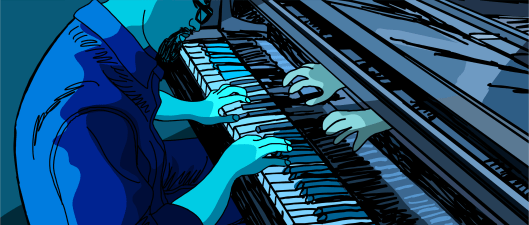
Tenorio Jr. at the piano. Photo credit: Javier Mariscal. Courtesy of Sony Pictures Classics.
Brazilian pianist Francisco Cerqueira Tenorio Jr., better known as Tenorio Jr., was at the beginning of a promising career when he vanished after playing the final concert of poet Vinicius de Moraes’s tour in Buenos Aires in March 1976. He was 34 years old.
They Shot the Piano Player, the new animated film directed by Spanish Academy winner Fernando Trueba and visual artist and graphic designer Javier Mariscal premiering at the Coral Gables Art Cinema in Miami on March 1st, is a music lover’s search for a response to the obvious question and more.
Trueba, a dedicated music fan whose previous animated feature film collaboration with Mariscal, “Chico y Rita,” was also about music and musicians, chose animation to tell the story because he “wanted Tenorio Jr. to feel alive.”
“That Rio where Tenorio came of age musically, those clubs, don’t exist anymore. I wanted that vitality and people to understand the context in which he moved,” said Trueba, speaking in Spanish from his home in Madrid. “And for me, that I love Brazilian music, it was an opportunity to explore the Brazil of the late 50s, early 60s, which was perhaps the country’s highest point.”
They Shot the Piano Player follows music journalist Jeff Harris, voiced by actor and pianist Jeff Goldblum. While researching to write a book about bossa nova, Harris, Trueba’s alter ego, hears an album featuring Tenorio Jr. He is deeply impressed but can’t find any recording by him after 1975, and becomes obsessed with his fate.
The search gives Trueba, a fan of Brazilian music, a chance to offer a delightful, if often melancholy, music history lesson as it revisits a Rio de Janeiro full of life, a creative moment bubbling with bossa nova and samba jazz, offering context and setting the stage for Tenorio Jr.’s rise. In Mariscal’s imagery and animation, it’s a Rio of dense, luxuriant colors, pulsating with music and no-stop movement.
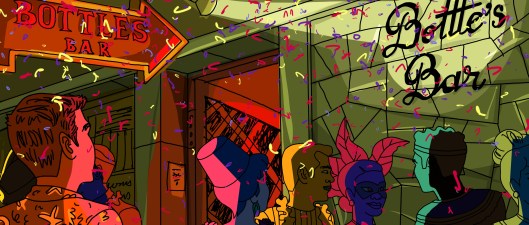
The Bottle’s Bar, a small but legendary club at the Beco das Garrafas (Alley of the Bottles) in Rio de Janeiro in the 1950s and 60s. Photo credit: Javier Mariscal. Courtesy of Sony Pictures Classics.
As a pianist, Tenorio Jr. has a light, clean touch that often evokes Bill Evans, one of his idols, a gift for melody and an easy, elegant swing.
He accompanied top artists such as Milton Nascimento, Egberto Gismonti, and Gal Costa, and his playing appears in several Brazilian music collections, but he recorded only one album as a leader, Embalo, released in 1964. Captured with elegance and a musical ear by Mariscal’s animation, the sequence rendering the studio recording of the title track, which featured an all-star cast, brings back the look and feel of “Calle 54” (2000), Trueba’s documentary on Latin jazz.
The film’s music includes several tracks by Tenorio Jr. but also a rich list of indispensable titles in Brazilian popular music, including “Chega de Saudade” (No More Blues), the alpha of the bossa nova movement, “So Danço Samba, “” Ela e Carioca,” and even a few bars of “Travessia,” Nascimento’s breakthrough song. Uncanny, animated versions of the late pianists Bebo Valdés and Joao Donato, towering figures in Cuban and Brazilian music, respectively, make cameos to play music by Tenorio Jr.
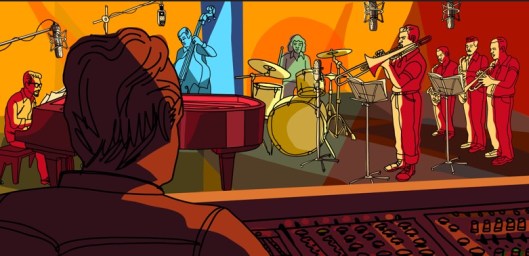
Tenorio Jr. in the studio. Photo credit: Javier Mariscal. Courtesy of Sony Pictures Classics.
As he pulls on the slender threads available to find some answers, Harris calls on a who’s who in Brazilian music, artists such as Caetano Veloso (who expected to record with the pianist at his return from Buenos Aires and says he “always felt very reverent before Tenorio because of his musical ability”), Edu Lobo, Chico Buarque, Gilberto Gil, Milton Nascimento, Joao Donato, and Paulo Moura. He also interviews American saxophonist Bud Shank, whose Brazilian-tinged jazz with Brazilian guitarist Laurindo Almeida in the mid-50s, foreshadowed the Brazilian music wave to come to the United States. He heard Tenorio Jr. on a visit to Rio and speaks animatedly of him and the Brazilian scene — only to be stunned into silence at finding out the pianist’s fate.
The film also offers a sobering look at dictatorships and state terrorism in Latin America in the 1970s, which ended up costing Tenorio Jr. his life.
It’s a few years and a short flight between the Beco das Garrafas (Alley of the Bottles), where small clubs became the hub for music in Rio in the 50s and 60s, and the dungeons and torture chambers at the Escuela Superior de Mecánica de la Armada or ESMA, (Higher School of Mechanics of the Navy), the secret concentration camp in Buenos Aires that under the military dictatorship (1976-1983) became the Auschwitz of Argentina.
Tenorio Jr. was not involved in any political activity and should’ve had nothing to fear. After the last concert, he just went back to his hotel with Malena, the woman with whom he was having a romance. Vinicius, Tenorio Jr., and the rest of the group were returning to Brazil the following day, and she wasn’t feeling well, so it was to be a quiet evening. Stories vary about what happened next. In one version, he decided to go looking for a pharmacy; in another one he was hungry, so he went looking for a place to buy a sandwich. Whatever the reason, he was out on the street at around 2 a.m. and to a gang of plainclothes policemen on the prowl, riding in an unmarked car, his youth, long hair, how he was dressed, and, upon arrest, the fact that he had a musician union’s card in his pocket, made him suspicious.
In those days, everyday life in Buenos Aires was poisoned by fear. Trapped in a logic of violence and murder carried on by police death squads, right-wing paramilitary gangs, and leftist guerrillas, Argentina had become a nation of suspects and enemies. According to the confession, decades later, of a corporal who was a member of the police gang, after a couple of days of interrogation and torture, the Argentines reached out to their Brazilian counterparts — and they confirmed that he was not involved in politics and was not a suspect in anything. But by then, it was too late. He couldn’t be freed. He could talk.
As Harris/Trueba notes, Tenorio Jr. became “a victim of two dictatorships.”
He was never seen again.
The perverse term desaparecido is Argentina’s contribution to the lexicon of terror.
“A desaparecido has no entity,” said dictator Jorge Videla in a press conference in 1979. “It’s not there. Neither dead nor alive. He is a desaparecido ( a missing person).”
To learn about Tenorio Jr. the man, Harris/Trueba also reaches for testimony from his wife Carmen (because his body was never found, she is not officially a widow), his children and grandchildren, and also from Malena, his companion in Buenos Aires.
“If you get to know a person by the people who love him, meeting Carmen and Malena tells you everything you need to know about Tenorio,” says Trueba. “And he was a serious person. He and Carmen had four kids, and they were expecting another child. Tenorio was not one to fool around. He was deeply conflicted by the affair.”
As we hear from the people who remember him, They Shot the Piano Player methodically adds up to the devastating costs of state terrorism in Latin America. Some are obvious and deeply personal — first, to Tenorio Jr., then to his family, and loved ones. And then there is the profound loss the death of such a talent represents to society.
The military coup in Brazil in March 1964 (the dictatorship then lasted until 1985) “stopped a Golden Age of Brazilian music in its tracks,” laments Harris/Trueba.
“I am not a musician, so I can’t explain it in technical terms,” says Trueba when asked what affected him so strongly about Tenorio’s playing. “But you could hear his touch, his ideas, and how he was bringing together jazz, Brazilian music, and classical music. He was on to something. He was special.”
An edited version of this story was published in Miami Artburst.
© 2024 Fernando Gonzalez
 Jazz With an Accent