
With Historia Gipsy Kings look back – and forward

Tags

, ,

Historia, the latest release by the Gipsy Kings featuring Tonino Baliardo, celebrates family and community with a familiar and successful sound.

The title of the Gipsy Kings’ most recent release, Historia (History), may suggest a retrospective, but the music, mixing the familiar with subtle innovations, sounds like a reaffirmation and a look forward. And why not? They have a distinct sound, built on a joyful, high-energy mix of Catalan rumba, flamenco, and pop, highlighted with brushstrokes of styles from around the world, and simple, direct lyrics sung mostly in Spanish, but also French, Catalan, and languages of southern France. The combination turned a group of Gypsy Romanis once seemingly destined to scratch a living performing in restaurants, street events or busking in the beaches of Saint Tropez, into a global phenomenon.

But success was never a given. Their first two albums were largely unnoticed.

But then, their third recording, released in 1987, included the monster hits “Djobi Djoba” and “Bamboleo,” and the Gipsy Kings were on their way. Since then, they have won a Grammy (in 2014 for Best Global Music Album), have been featured in the soundtracks of Hollywood feature films including Toy Story 3 and The Big Lebowski, sold more than 25 million albums, have had in excess of 2 billion streams, and played to full houses all over the world.

“No, I never imagined that kind of success,” said Gipsy Kings leader, founder and main composer Tonino Baliardo, speaking in French through a translator from his home in the South of France. “We thought we could make a little living. We were doing private parties, and we did a little bit of work in Saint Tropez, but very little. When it exploded onto the world scene, it was just quite remarkable.”

They will be appearing at the James L. Knight Center in Miami on Saturday, August 15, at 8 p.m.

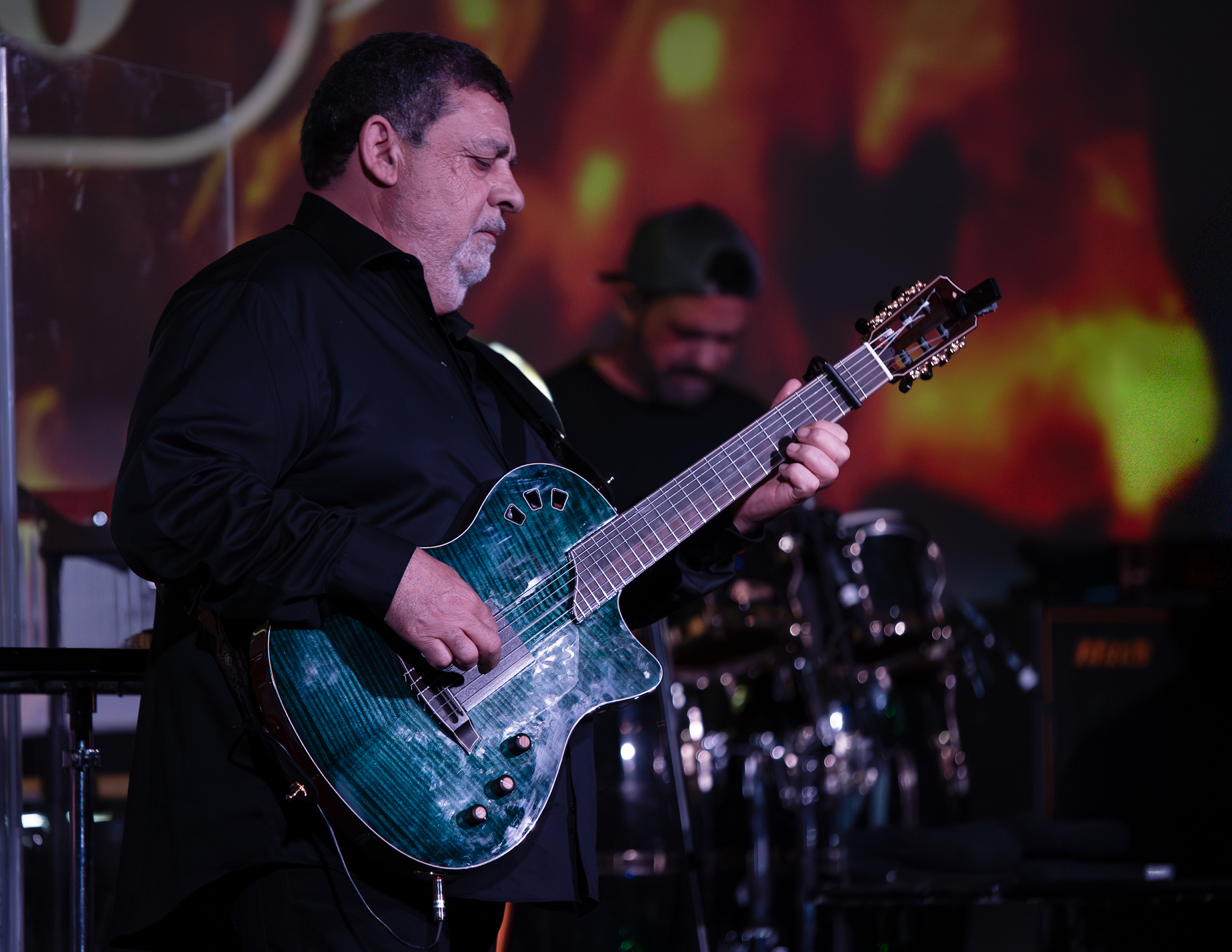
Tonino Baliardo, Gipsy Kings’ leader, founder, and main composer, once thought of making “a little living” playing community events, private parties near his home in the South of France. Becoming a global phenomenon? “No, I never imagined that kind of success,” Photo by Tobin Hill, courtesy of Gipsy Kings

The group was founded in 1979 in Arles, France, and featured two sets of brothers, the Baliardos (Tonino, Paco, and Diego, nephews of the great flamenco guitarist Ricardo Baliardo, better known as Manitas de Plata) and the Reyes (Nicolas, Canut, Paul, Patchai, and Andre, sons of Manitas’ cousin, flamenco singer José Reyes). Manitas de Plata and Reyes performed as a duo in the 1970s. It’s a story that speaks of a close-knit community, strong family ties, a fierce attachment to their traditions and legacies that must be honored.

Tonino Baliardo once called Manitas de Plata “the original Gipsy King.”

Over the years, the group has featured several personnel changes, while remaining a family affair. This iteration of the Gipsy Kings features Tonino’s sons, Cosso and Mikael.

Gipsy Kings featuring Tonino Baliardo, center, with his sons Mikael Baliardo (first from left) and Benji “Cosso” Baliardo (second from left) The group was founded in 1979 in Arles, France, and since it  has had different lineups. Mikael and Cosso Bailardo have been part of the group since 2014. Photo courtesy of Gipsy Kings featuring Tonino Baliardo

Musically, “with ‘Historia’ I wanted to make a new album preserving our sound, our gypsy feel, but with new melodies, new energy,” said Baliardo. “I love having my sons play with me. They grew up with this music, so they’re rooted in the culture. But they bring a young energy, a young spirit. And I also learn with them because music has evolved so much the past 35, 40 years.”

As to how they call their music and the blurry line in it between rumba Catalana, a style that emerged in Barcelona in the 1950s, and rumba flamenca, one of the palos or classic styles in flamenco, Baliardo sounds unconcerned. “At the end of the day, we are originally from Catalonia,” says Baliardo with a shrug.  “My parents were born in Barcelona, Catalonia. So, we call it rumba Catalana (Catalan rumba).”

Over the years, the Gipsy Kings have added to it elements drawn from different sources, from Brazilian music and reggae to Algerian rai. “Historia” includes touches such as jazz piano solos, a hint of a montuno, and electric guitar rock solos.

“We kept the rhythms, the sound of the guitars. We call it the compas, and over that, our sound is always evolving,” explains Baliardo. “We always learn something in our world tours, new styles, new things.”

But the overall theme in the album, not surprisingly, remains family and community.

Songs such as “El Campo,” (the Countryside) a snapshot of life among the Romani, “Primavera” (Spring) which starts with the line “I remember the time I spent in this neighborhood where I was born, life was sweeter, more beautiful,” or ‘La Guerra” (The War) an anti-war lament that hints at the impact of war in so many Spanish Romanies’ family histories, including the Baliardos, who were once refugees from the Spanish Civil War. Even the instrumental “Cielo” (Heaven) is a deeply personal statement, a tribute to Tonino’s brother Paco, who passed away in April 2025.

“In Historia I wanted to tell the story of our ancestors, the story of our community,” says Baliardo, the main composer in the group. “It revolves a lot around that, about telling the long history of the Roma people, the Gypsies, and spreading that message throughout the world.”

His favorite song, however, is the title track “because [in it] we welcome the people who come to see us at the concerts and invite them to have a party with us,” says Baliardo. “We have seen people so happy, partying, dancing in our concerts – and people were crying too, because something in the music touched them. And it’s a public that has been following us for years. Now it’s their children who come to see us because they have listened to our music with their parents. So, the story continues.”

This story first appeared in ArtburstMiami.com 


Ignoring Musical Borders and Embracing Discovery, The GroundUP Music Festival Celebrates Its 10th Anniversary


Michael League (center) leading a performance of Snarky Puppy at the Miami Beach Bandshell in Miami Beach, Florida, in 2024 Photo by Jason Koerner Courtesy of GroundUP Music Festival

Ten years is a lifetime in the music business. That alone would make the GroundUP Music Festival remarkable. How it got here makes it one of a kind.

“We’re trying to shine a light on great artists who aren’t already very, very well known,” says Michael League, leader of the enterprising 20-member jazz collective Snarky Puppy and co-founder of the event. The 10th anniversary of the festival begins Friday, March 13, at the Miami Beach Bandshell and continues through Sunday, March 15.

“We’ve definitely had some artists on the (GroundUP) label at the festival with slightly bigger names. But for me, the heart of the festival is the artists people haven’t heard of when they come, but then can’t stop talking about when they leave. Rather than a place to go to hear the people that you’re already a fan of, we try to make this festival a discovery point for people.”

A five-time Grammy Award-winning multi-instrumentalist, producer, composer, arranger, and songwriter, League started the GroundUP Music label in 2012 as a home for Snarky Puppy. Five years later, he and Miami Beach native and resident Paul Lehr, founded the annual music festival and the nonprofit GroundUP Music Foundation. (Michael League photo courtesy of GroundUP Music Festival)

Headliners this year include League’s Snarky Puppy, which performs every night, including a full “Family Dinner” set in which the band accompanies featured performers.

Also featured in this year’s GroundUP Music Festival are multidisciplinary musician and filmmaker Flying Lotus (aka Steve Ellison); singer and songwriter Rickie Lee Jones; pianist, keyboardist, composer, and producer Patrice Rushen; singer, songwriter, and producer Bilal; guitarist Isaiah Sharkey; vocalist Arooj Aftab; guitarist Julian Lage; multi-instrumentalist and singer Alain Perez; and flutist and vocalist Varijashree Venugopal.

The festival takes place on the main Bandshell stage and in the surrounding park area. The program also includes workshops and encounters such as “Artist to Artist”: Patrice Rushen interviewed by Justin Stanton; “The Legacy of D’Angelo”: Isaiah Sharkey interviewed by Bilal; Rickie Lee Jones on “Creativity in Popular Song”; and “Mind Games: Mentality in Music Production” with League.

Paul Lehr, CEO of the GroundUP Music Foundation, recalls his time as CEO of YoungArts, the national arts competition in Miami.

“We ran similar programs. That was where I formed the idea of doing small workshops and master classes, keeping things intimate,” says Lehr. (Photo Courtesy of GroundUP Music Festival)

The standard format for large festivals is not one GroundUP tends to emulate. Accessibility to the artists is a plus, notes Lehr.

“Usually, at festivals, artists will come in, go to their trailer, go to the stage, play, go back to their trailer, and be gone. With us, the artist stays the entire weekend,” says Lehr. “That breaks down the barriers between the artists and the audience. You can go up and talk to Isaiah Sharkey or Bilal or Flying Lotus or whoever else because they’re sitting there watching the other shows—and that changes the experience.”

He credits League for the curation.

“He is one of the most phenomenal musicians on the planet, featuring some of the best artists most people have never heard of. So we have just a different approach from the artist selection standpoint.”

The tone of the event was set early on. Memories of the late David Crosby calmly wandering about, checking the performances while waiting to play his set, or watching Cuban singer and guitarist Eliades Ochoa, of Buena Vista Social Club fame, enjoying a quiet moment with his family and having ice cream, come to mind.

But the setting also encourages unplanned musical moments and spontaneous collaborations.

“A lot of collaborations between the artists have been born at GroundUp,” elaborates Lehr. “And then [these collaborations] take on new lives of their own. That’s part of the purpose of the festival and also one of reasons why the artists want to come, play and be a part of this.”

Rushen, a much decorated player composer and producer was intrigued by the ideas and will be appearing for the first time in South Florida with her septet. For her, such an approach “is actually more in keeping with what it was supposed to be: a community of people who share their interest in the music and have an opportunity to spend time in an environment where the focus is the music, whether you’re a player or you are a fan.”

Ten years ago, talk around the GroundUP Music Festival of creating a community around a shared platform—notions of a generous, globally reaching diversity and creative musical ideals—sounded commendably idealistic, but also likely to crash against the bottom line. Yet a decade later, GroundUP is alive and thriving.

Lehr and League are exploring taking their concept to other locations. Last summer, for the first time, GroundUP Music staged the festival outside Miami Beach, in Italy. A second edition is scheduled in Alberobello, Southern Italy, next June. “Our hope is to very, very slowly consider other places where it makes sense to do this. But,” adds Lehr, “my intention is to make sure that we also always keep it here.”

As musicians’ livelihoods face challenges ranging from the economics of streaming services to political changes and the threat of AI, developing and nurturing an alternative business model built on higher values, networking, and community might not be as unrealistic as it might have sounded once upon a time.

The 5-time GRAMMY winning collective Snarky Puppy performing at the Miami Beach Bandshell as part of the GroundUp Music Festival. Photo Credit Osmany Torres Courtesy GroundUP Music Festival

That said, the attacks against diversity, equity, and inclusion are not parlor discussions but have dire, practical consequences, especially for an event that, as Lehr notes,”over the past 10 years, almost 70% of our audience have come from 50 states and 55 countries.”

“We are about community and diversity, and our audience comes from all over the world. Many literally fly in for this,” he notes. “It’s a small, intimate event. But when you turn around, this person is from Spain, this person is South African, this one is from Australia, and this one came from Ohio. It’s a diverse community united by music and camaraderie. I’ve spoken with and heard from many of our Canadian attendees, and almost to a person, they told me they’re not coming to the festival because they don’t want to come into the country.”

The festival started like a fun proposition, reflects League. “The idea of just calling all of your musician friends and getting them together in the same place is a dream for anyone who plays music. Now, this was before COVID, before all of the political upheaval in the U.S., and before this kind of oligarchical takeover. It started as just a fun thing that we were all interested in doing.”

Now it’s different, he says.

“It feels a little more vital, especially as the music industry is crumbling in many respects. Live music is emerging as the one pillar, the last thing we’ll have if everything else goes. And so I think the festival sticking around is a statement.”

For a detailed schedule and tickets check https://www.groundupmusicfestival.com/dailyschedule

An edited version of this story was first posted at Artburst Miami

Traditions renewed: A Bomba y Plena big band and Caribbean hip-hop with a Miami accent.

The pairing of Puerto Rican 15-piece bomba y plena big band El Laberinto del Coco and Miami-born and raised rapper Marti at the Miami Beach Bandshell Saturday, July 19, at 8 p.m. is a meeting of evolving old and new traditions.

Led by percussionist and composer Hector “Coco” Barez, the 14-piece band El Laberinto del Coco updates the sound of Afro-Puerto Rican bomba and plena with elements of jazz, R&B, rock, hip hop, and global influences from the Americas. Rapper Marti, AKA as Mario Obregon, embodies Miami’s multiculturalism, performing in both English and Spanish over a sound that seamlessly blends elements of R&B, NuSoul, and Caribbean grooves. The show is presented by The Rhythm Foundation and Live Arts Miami’s MUNDO Series.

Continue reading