
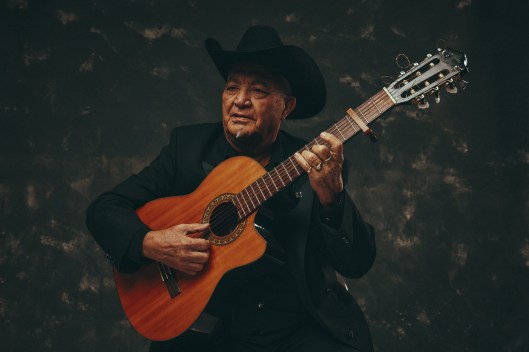
Eliades Ochoa. Photo by Massi Giorgeschi courtesy of Eliades Ochoa’s management
Singer, guitarist, and songwriter Eliades Ochoa may be a traditionalist in music but does not trade in nostalgia.
He achieved international fame as a charter member and key figure of Buena Vista Social Club, a Grammy-winning 1997 album featuring fresh interpretations of traditional Cuban songs and styles by artists such as singers Omara Portuondo, Pio Leyva, and Ibrahim Ferrer, singer and guitarist Compay Segundo, and pianist Ruben Gonzalez, among others.
It became a global phenomenon.
Ochoa, who had been playing from a very young age and was 50 years old at the time of Buena Vista, rode the wave but kept moving. He still is. As the headliner of the Afro Roots Fest opening concert at the Miami Beach Bandshell on Saturday, March 16, Ochoa will present his most recent album, Guajiro. (Peasant) The recording marks yet another turn in his long career as it showcases his work as a composer and expands the sound of his customary quartet.
“I wanted to make this new album a little more contemporary,” says Ochoa, speaking in Spanish, freshly arrived from Madrid, where he resides. “There are boleros, a habanera, guaracha, changüí, sones, but I wanted to have different melodies, different harmonies, and you’ll also hear a saxophone and a trumpet, something very different from what I have been doing for a long time.” (At the Bandshell event, Ochoa will be backed by his United States-based quintet including saxophone and trumpet.)
Guajiro also features collaborations with Panamanian singer Ruben Blades, singer and songwriter Joan As Police Woman (Joan Wasser), and old friend, harmonica master Charlie Musselwhite.
In its 26th year, Afro Roots Fest celebrates root African culture and its synergies with Western cultural traditions. Ochoa, who has long embraced such encounters, seems to sum up the spirit of the event. In fact, he has a history of collaborating not only across musical styles but cultural traditions. “It opens the doors to both cultures,” he told a British publication. “Music doesn’t have borders.”
Perhaps most notably, he has recorded albums such as CubAfrica (1996), a collaboration with the late Cameroonian saxophonist Manu Dibango, and the Grammy-nominated AfroCubism (2010), which documents a meeting of Cuban and Malian musicians, including masters kora player Toumani Diabate.
Meanwhile, even a cursory look at Ochoa’s extensive recording career would confirm his choice of being an interpreter for some of Cuba’s great songwriters. But in Guajiro, Ochoa claims his place as a composer.
“I had in mind that if Pepe Sanchez [regarded as the father of bolero] had made such a beautiful bolero, why would I make another one that was not as good?” says Ochoa modestly. “But then, my partner [author] Grisel Sande and my daughter, Evora Vicents, insisted that I could not think that way, that I had many boleros that were good, beautiful songs. Until then, when I made a record, I would include one of my songs, maybe two, but not always. I thought there was already a lot of beautiful music and no need to include my songs. But they took that idea out of my head, and I started to play them.” More than half of the tracks in Guajiro are his.
The subjects and the styles cover a lot of ground, from the optimistic opening track “Vamos a Alegrar el Mundo” (Let’s Make the World a Happier Place), the poetic “Abrazo de Luz” (Embrace of Light) and “Creo en la Naturaleza,” (I Believe in Nature) sang with Wasser, alternating Spanish and English lyrics, to “West,” his collaboration with bluesman Musselwhite.
He wrote ‘Abrazo de Luz” while looking out a window while enduring the COVID-19 confinement. “I was locked inside the house, and I saw that first light of the sun announcing a new day, and I just wrote down what I was thinking,” says Ochoa. Meanwhile, “West” is partly a tribute to his childhood in Santiago de Cuba, when he saw “three Western movies for 10 cents. All those shootouts!” he says. “At first, the song was like Western instrumental music. Cowboys on horseback would come to my mind — and later, I came up with the lyrics. Well, that’s where this thing of cowboy hats and boots comes from. I have always liked to walk with boots, and now it’s my image.”
The album also includes two old carnival hits by singer and songwriter Sergio Rivero, “nicknamed “El Haitiano.” His two pieces, “Ando Buscando una Novia” (I’m Looking for a Girlfriend) and “Anita Tun Tun Tun,” “lean to merengue, “notes Ochoa. “The songs have that merengue vibe because he was from Santiago de Cuba. He always had that intensity.”
Ochoa is one of only a handful of survivors of the Buena Vista Social recordings, and more than twenty-five years later, even after answering a question he was likely asked a few hundred times, he still sounds surprised by the enduring impact of those sessions.
“If one of us, one of the founders of the Buena Vista Social Club, says he knew what was going to happen, he is lying,” he says. “What we did know was that we were working for an Englishman [Nick Gold, the CEO of World Circuit Records] and an American [guitarist, composer, and producer Ry Cooder] and that what we were doing, we were doing it with respect and love. Did we think it was going to be a good record? Yes. Did we know this would be a home run with the bases full in the ninth inning? Nah. Nobody knew that.”
Looking back has its rewards, but for Ochoa, there is nothing like discussing his present.
“I feel very happy when I’m on stage and see the audience and a lot of young people,” says Ochoa. “I hear them singing the choruses of the songs on the recent albums, and you realize that they know what they are going to hear, and I like that a lot.”
An edited version of this story was published by Artburst Miami and Miami Herald.
© Fernando Gonzalez
 Jazz With an Accent