Jazz has long become a global language, and Jazz With an Accent ®, on the radio and as a blog, is a way to find out and explore the ways musicians around the world have cross-referenced jazz and their traditions to tell their stories.
It wasn’t planned, but as I put the playlist together, tonight became an evening of string theory, showcasing guitars, both electric and acoustic, an oud, and a bassist and cellist. And, as it has become the norm here, in the time we have we are traveling pretty far and wide, geographically, and stylistically. Step right in.
Jazz has long become a global language, and Jazz With an Accent ®, on the radio and as a blog, is a bit of armchair traveling, a way to find out about and listen to the ways musicians around the world have blended jazz and their traditions to tell their stories. Sometimes, we don´t have to travel far.
To my mind, the title of tonight’s program is “The Other Islands.”
It´s just a very modest sampling.
There is enormous musical wealth in the Caribbean besides Cuba. Consider Puerto Rico, Haiti, the Dominican Republic, or Trinidad, each with its own deeply rooted traditions and talented musicians raised on that music but also educated in the ways and tools of jazz.
For many years, the term Latin Jazz meant Afro-Cuban jazz. But then artists such as Paquito D’Rivera and Gato Barbieri and young talents such as Puerto Rican saxophonist David Sanchez, Venezuelan pianist Edward Simon, and Panamanian pianist Danilo Perez exploded narrow definitions of Latin Jazz with a truly Pan-American approach. These days, no one would raise an eyebrow if an artist gives their Latin jazz a flamenco accent, and constructs it using a cumbia swing or drumming from candombe. The Ibero-American music universe is vast.
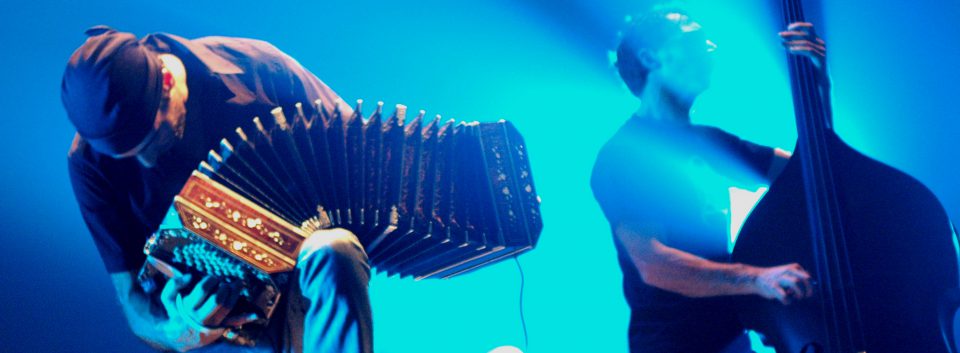
The accent of tonight’s Jazz With an Accent ® program is jazz tango. We will hear an early attempt at jazz tango by Astor Piazzolla and his Jazz Tango Quintet from his album Take Me Dancing: The Latin Rhythms of Astor Piazzolla, recorded in 1959. Piazzolla, who grew up in New York, had returned to the city feeling ignored in Buenos Aires and hoping to re-launch his career. But he was struggling mightily. He was trying to support his family as a player and arranger (he wrote for Machito and Noro Morales, among others), and then, at one point, he imagined jazz tango as a way to break into the American market. He recorded two albums for Tico Records, Take Me Dancing and Evening in Buenos Aires, a Mantovani-like tango recording with an orchestra that became Piazzolla’s “ghost record.” Never released in the States, it was a mystery to his followers for decades. (It was finally released on a Japanese label in 1994). Piazzolla was enthusiastic about the results at first (“The recordings are marvelous,” he exulted in one letter), but he later disavowed the whole project, calling them “a monstrosity.”
I remember asking Piazzolla about them in one of our conversations. I told him I had seen the titles in discographies but couldn’t find them anywhere. “Good,” he said emphatically. “They should stay lost.”
And that was that.
While not his best work by any measure, Take Me Dancing was a worthy failure, suggesting ways to re-imagine jazz and tango. Five decades later, Brooklyn-based Argentine bassist, bandleader, and producer Pablo Aslan, a pioneer in jazz tango in the United States, found a copy of the album and was intrigued. He ended up transcribing and re-recording the arrangements, only now with musically bilingual players who knew jazz and tango, including Piazzolla’s grandson, drummer Daniel “Pipi” Piazzolla. As I wrote in the liner notes, Aslan´s Piazzolla in Brooklyn is neither a remake nor nostalgia. It’s not even approached as a tribute. Instead, it’s part of a continuing conversation between musicians from different eras who took their leaps on a continuing, open-ended search.
The program tonight also includes a Venezuelan classic by D’Rivera, Italian trumpeter Enrico Rava embracing tango in Buenos Aires, a track by long-time Piazzolla’s pianist Pablo Ziegler from his album Jazz Tango, which won a Grammy in the Latin jazz category in 2017, and a reading of Piazzolla’s “Prepárense” (Get Ready), by saxophonist Gato Barbieri from his final studio album New York Meeting, released in 2010.
 Jazz has long become a global language, and Jazz With an Accent ®, on the radio and as a blog, is a way to find out and explore the ways musicians around the world have cross-referenced jazz and their traditions to tell their stories.

 Jazz With an Accent