

Jazz has long become a global language, and Jazz With an Accent ®, on the radio and as a blog, is a bit of armchair traveling, a way to find out about and listen to the ways musicians around the world have blended jazz and their traditions to tell their stories. Sometimes, we don´t have to travel far.
To my mind, the title of tonight’s program is “The Other Islands.”
It´s just a very modest sampling.
There is enormous musical wealth in the Caribbean besides Cuba. Consider Puerto Rico, Haiti, the Dominican Republic, or Trinidad, each with its own deeply rooted traditions and talented musicians raised on that music but also educated in the ways and tools of jazz.
The role of Puerto Rican musicians in the evolution of Afro-Cuban jazz cannot be overstated. Cuban trumpeter, saxophonist, and bandleader Mario Bauzá, the mastermind and music director of Machito and his Afro-Cubans and a crucial figure in the creation and development of Afro-Cuban jazz, once told me, “We Cubans owe a debt of gratitude to Puerto Rican musicians. They kept our music alive.”

But Puerto Rico has its own rich musical traditions, and in the 1990s, a new generation of players and bandleaders, Puerto Rico’s own “Young Lions,” set out to celebrate them and reimagine them. We’ll hear two key players of this movement: trombonist and bandleader William Cepeda and his group, Afro-Rican Jazz, playing “Bomba Pa’ Loiza,” a tribute to his hometown, Loiza, arguably the heart of Afro-Puertorican culture, from his album Branching Out.
William Cepeda at Berklee’s Valencia Campus (Photo Fernando Gonzalez)

And we’ll hear saxophonist Miguel Zenón’s “Villa Palmera” from his album Esta Plena, in which he explores the genre. Throughout his career, Zenón has methodically surveyed Puerto Rican music, including música jíbara (country music), the Puerto Rican popular songbook, and the work of artists such as Ismael Rivera.
Photo of Miguel Zenón by Jimmy Katz ©
We´ll close the first half listening to two exceptional musicians, each incorporating the ritual music of voudou in their distinct ways: We’ll hear ‘Kouzin’ by Guadeloupean saxophonist Jacques Schwarz-Bart from his album Jazz Racine Haiti. In ‘Kouzin,’ Schwarz-Bart seamlessly weaves together jazz, ritual drumming, and singing. And then we´ll listen to Haitian-American trumpeter and flugelhorn player Jean Caze, his song Gran Manjé,’ featuring vocalist Emeline Michel, singing in Kreyol.
Caze grew up listening to Haitian music and dancing. “I always felt that the typical jazz was a bit limiting,” he told me in an interview earlier this year. But he rediscovered Haitian roots music and heard the potential of its blend with jazz almost by chance.
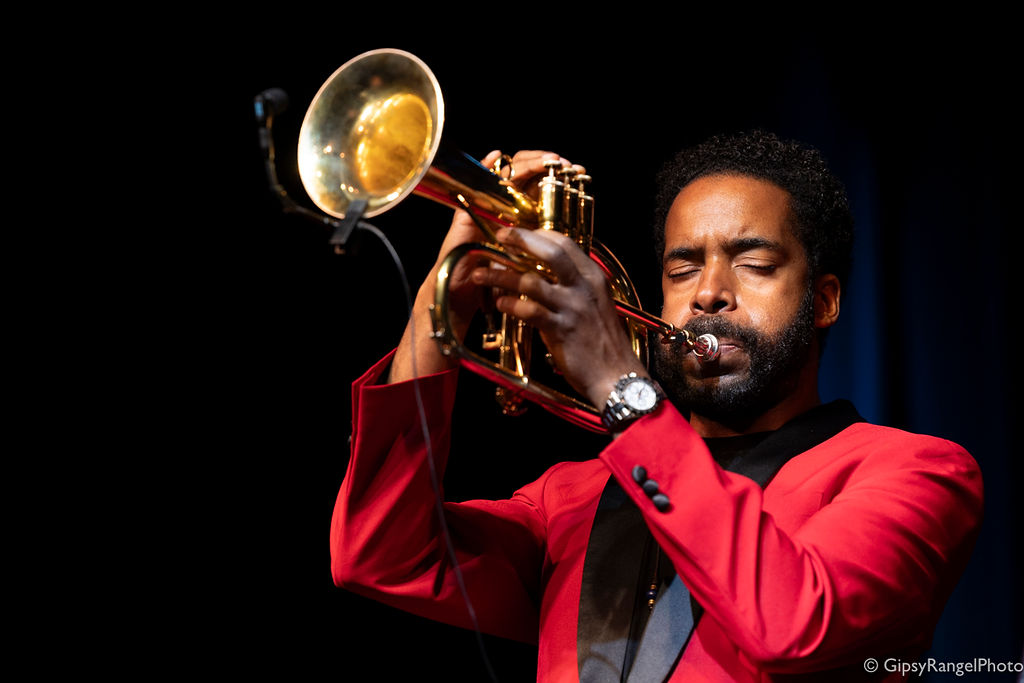
“As I was finishing college, I got a call from Haitian pianist and composer Reginald Policard inviting me to go to Haiti to play in the Port-au-Prince jazz festival,” he recalled. “I improvised over these rhythms and thought, ‘Wait a minute. This is different. This is more fun and interesting than copying Miles Davis or doing what was already done by other people.'” He hadn’t heard recordings of Haitian jazz, so the experience was liberating. “I wasn’t told what I was supposed to do, so there was this very open, exploratory feeling to the music.” His first album as a leader, Miami Jazz Scene (2006), was a solid jazz fusion effort. But in his most recent album, Amédé, in which he suggests a smooth, organic blending of urban jazz sound and Haitian traditional drumming, he opens the door to a new musical universe.
Jean Caze in performance at The Koubek Center earlier this year. Photo by Gipsy Rangel, courtesy of The Koubek Center. ©
African culture has a wide and profound presence in the Caribbean.

In “Bibisa,” a track from At Home Live at Marciac, we’ll hear a snapshot of the collaboration between Cuban pianist Roberto Fonseca and Malian singer Fatoumata Diawara, exploring the deep musical connections between Cuba and West Africa.
The Dominican Republic has a rich musical tradition, and tonight, we’ll feature two of its most notable musicians. We’ll hear first the late saxophonist Mario Rivera reimagining Frank Foster’s “Frank’s Song” with a merengue beat from his album El Comandante del Merengue Jazz (1996). Remarkably, Rivera, who died in 2007, had a rich musical career, including stints with Tito Rodríguez, Mongo Santamaría, Eddie Palmieri, and Machito, but also with avant-jazz-pop composer Kip Hanrahan, Dizzy Gillespie’s United Nation Orchestra and Chico O’Farrill’s Afro-Cuban Jazz Band. Yet Rivera only recorded that one album as a leader.
Above, Fatoumata Diawara performing at the Miami Beach Bandshell. Photo by Luis Olazábal.
And we’ll close tonight’s program with Trinidadian trumpeter Etienne Charles and Dominican pianist Michel Camilo. From Charles, we’ll hear “Roots” from his album Folklore. Then we’ll listen to Camilo’s “You and Me,” a bolero from his album Mano a Mano, a trio recording featuring Puerto Rican percussionist Giovanni Hidalgo and the late Cuban bassist Charles Flores.
Camilo is a virtuoso player with a big sound and an exuberant approach (to my ears, his piano often suggests a big band; perhaps that’s why his large ensemble recordings sound so natural). But for this show, I wanted to play you a different side of his playing, something a bit more intimate. I remember a teacher at the music school telling us that it was much harder to play a ballad than to race up and down, playing scales and patterns on a fast piece. Those of us spending hours stumbling over Parker’s licks or a Coltrane solo quietly snickered. But he was right, of course.
There is no place to hide in a ballad. And what a musician doesn’t play, his restraint in adding only what’s needed speaks volumes.
Listen to what Camilo does here.
Join us tonight at 7 p.m. EST at
There is a world of jazz to discover.
If you’d like to reach me, please write to me at fernando@jazzwithanaccent.com
Playlist
- Miguel Zenón Villa Palmera
- William Cepeda Bomba Pa’ Loiza
- Jacques Schwarz-Bart Kouzin
- Jean Caze Gran Manjé
- Mario Rivera Frank’s Tune
- Roberto Fonseca with Fatoumata Diawara Bibisa
- Etienne Charles Roots
- Michel Camilo You and Me

 Jazz With an Accent