
 Jazz has become a global language. In Jazz With an Accent ®, we explore the many ways musicians around the world have reimagined their traditions with the tools, strategies, and history of jazz, and vice versa.
Tonight, we’ll explore collaborations. Half of the program will feature music by Western jazz artists and African musicians, crossing the imaginary lines between musical traditions and their rules. In the second half, we’ll explore flamenco jazz and its evolution, featuring a historic, breakthrough recording and a couple of snapshots of recent encounters, including one of its descendants, so to speak.
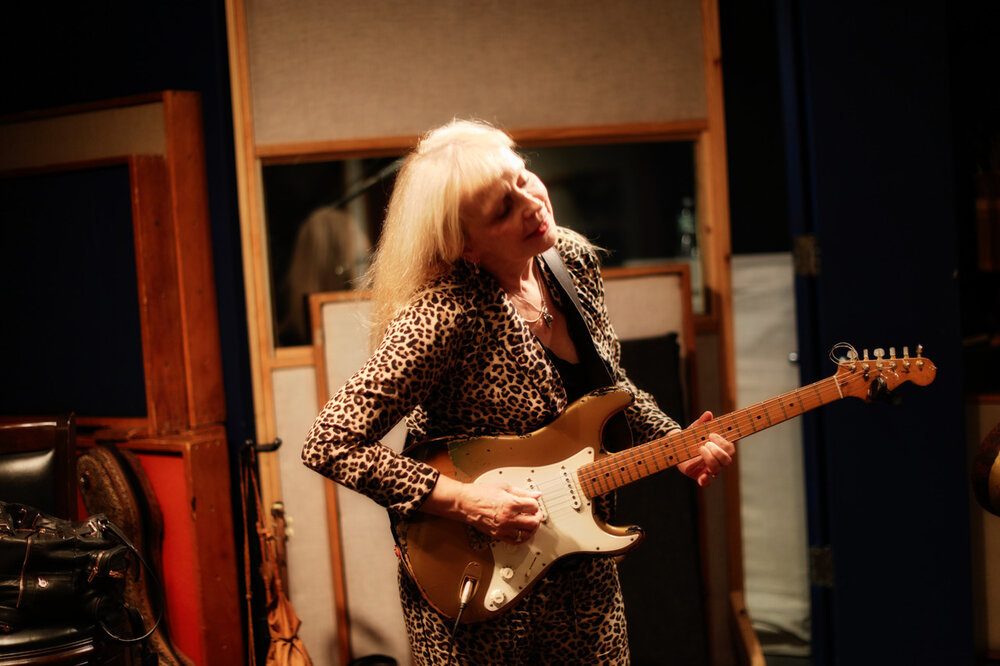 We’ll open with German guitarist Leni Stern and “Ousmane,” a track from her album Africa. This was no hit-and-run cultural sightseeing by Stern. She began by living and working several months a year in Mali and Senegal, resulting in the EP Alu Maye (Have You Heard) recorded in Mali at Salif Keita’s Bamako Studios. The follow-up, Africa, was two years in the making and involved a large cast of African instrumentalists and singers as well as contributions by saxophonist Michael Brecker (in one of his final recordings) and guitarist Mike Stern, Leni’s husband. (Photo of Leni Stern by Sandrine Lee)
On her website, Stern mentions that she played in Salif’s band, also with Senegalese singer-guitarist Baaba Maal, and learned from kora master Toumani Diabaté and says that she was “paying homage to the African roots of jazz, studying with real masters, getting to know the rhythms of the music, the languages, and life there.”
The proof is in the music.
 We’ll follow Stern’s track with music by the incomparable Malian singer Salif Keita from a collaboration that, at the time, raised a few eyebrows. We’ll hear “Waraya,” from his album Amen, which was produced by Joe Zawinul, who also plays on it. Fusion is a much-maligned term in jazz because it often suggests compromises by which the whole is less than the sum of the parts.
To my ears, in this encounter, both Keita and Zawinul remained true to their musical ideas yet came up with something different from where they started. Looking back, it’s intriguing to consider what, if any, impact Amen (recorded in 1991) had on the path Zawinul chose to follow later with his groove-heavy, African-influenced editions of his Syndicate.
The first half of tonight’s show closes with pieces by two very different pianists committed to serious explorations. We’ll hear “Komidiara,” a track from Hank Jones with Malian multi-instrumentalist, arranger, and composer Cheik-Tidiane Seck’s Sarala, a recording from 1993.
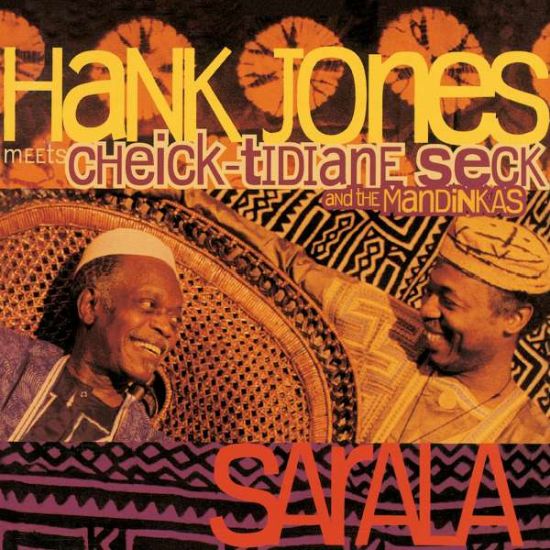 In the album notes, Seck writes that “Hank’s approach to Mandingo music, which has subtle threads close to blues and jazz, was as serious and humble as all his other undertakings. He studied this culture for months before playing a note and worked especially hard on the modal aspects of the music. If at the beginning it marked a return to his sources, Hank integrated all his efforts into this recording with total harmony, and at the outcome, it was as if he had never left his roots.”
“Komidiara” features Jones on piano and Seck on Hammond B3 and the succinct line about the lyrics of the piece simply states: “Rich you are the friend of all; poor you are abandoned,” which brings to mind pianist Jimmie Cox’ “Nobody Knows You When You’re Down and Out.” A universal theme, it seems.
The other substantial collaboration we’ll sample tonight is by avant-garde German pianist, composer, and producer Joachim Kuhn, Moroccan singer and guimbri player Majid Bekkas (the guimbri is a three-string lute-like instrument), and Spanish percussionist Ramon López, in a recording featuring local Gnawa musicians. We’ll hear “Foulani,” from the album Out of the Desert, recorded in Erfoud, described in All About Jazz as a “remote desert town.”
The second half of the program tonight starts with Spanish saxophonist Pedro Iturralde and a track from his influential album Jazz Flamenco, recorded in 1967. In it, he features a guitarist credited as Paco de Algeciras. He would soon be known globally as Paco de Lucia.
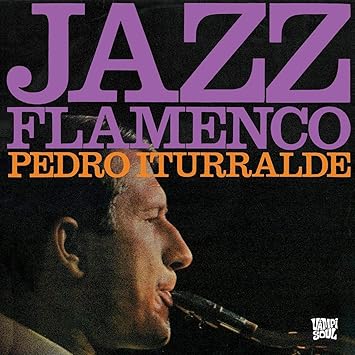 As it turns out, Iturralde called on De Lucia when critic Joachim Berendt, who had heard of Iturralde’s experiments with flamenco, invited him to be part of the Berlin Jazz Festival as part of a Jazz Meets the World program. At Berendt’s suggestion, Iturralde added a flamenco guitarist to his quintet.
“The first flamenco guitarist I worked with was Paco de Antequera, but for Berlin, I went with Paco de Lucia,” told me Iturralde in an interview in Madrid in 2004. He died in 2020. “Paco was a great player but didn’t know anything about jazz. We recorded in Berlin [the album is out of print], and came back and did Volume 2. He appears as Paco de Algeciras because of contractual problems.”
“Now [flamenco jazz] is something accepted, but back then, it was hard, very daring,” recalled Iturralde.
Tonight we’ll hear Iturralde’s “Cafe de Chinitas,” featuring 20-year-old Paco De Lucia in his first flamenco jazz recording.
Even in this, De Lucia was the different one. In the short history of flamenco-jazz, jazz musicians have consistently seemed more interested in flamenco than their flamenco counterparts in jazz.
“In principle, jazz and flamenco have nothing to do with each other,” told me years ago Jose Manuel Gamboa, a musician, critic, and author of Guia Libre del Flamenco (Free Guide to Flamenco) (SGAE,2001) “Both share an improvisational aspect and flamenco and some jazz are both modal music. But flamenco had been much more stuck in place than jazz. As for encounters, the first impulses have actually come from outside,” noted Gamboa, who also wrote the notes for the collaboration between Dave Holland and Pepe Habichuela that we’ll hear and discuss later. “The most significant move is Gil Evans – Miles Davis’s Sketches of Spain, and then also [John] Coltrane’s Olé, and even before that, there are certain things. But for flamenco, the impulse was what was done in America, because flamenco musicians were people completely closed up in their own world, so a lot of what happened out there didn’t mean much to them. Flamenco spent so much time holding on to the traditional forms with an almost absolute dearth of harmonies, while jazz opened up more and more. Now that has changed.”
Our next artist is saxophonist and singer Antonio Lizana, one of Iturralde’s musical descendants, and we’ll hear the track “Razón” from his album De Viento.
 As for flamenco-jazz collaborations, we’ll hear a piece from Hands, an album by bassist and bandleader Dave Holland and the great flamenco guitarist Pepe Habichuela, the patriarch of the Carmona family one of the great flamenco dynasties. Habichuela is part of the great generation of Paco de Lucía, Camarón de la Isla, Enrique Morente, and Manolo Sanlúcar. We’ll hear the rumba flamenco “El Ritmo me Lleva,” from their album Hands. This track features guitarist Josemi Carmona, son of Pepe Habichuela, a leading figure of Flamenco fusion, and a founder of the flamenco pop-jazz group Ketama.
(Photo of Pepe Habichuela and Dave Holland from the album Hands by Cesar Merino. The line “El sonido es el sonido,” translated by Gamboa in his notes as “The sound is everything,” is by Habichuela)
In his text for the recording, Habichuela noted that “Our work together has come about in a very natural and respectful manner. I am, above all, surprised by his desire to get to know the essence of Flamenco in its pure state, the type of Flamenco that I know and do, and the result of this has been full of emotion, expression, and wisdom. […] I can now say that we are now two Gypsies, or better yet still, he is now a Gypsy, and I am almost an Englishman.”
 And to offer a bit of context, we’ll close with a sampling of Iturralde, the jazz musician, playing straight-ahead jazz. Back in Madrid, he played at the Whisky Jazz Club where he shared the stage with visiting musicians such as Don Byas, Lee Konitz, Gerry Mulligan, and Hampton Hawes.
Iturralde will take us out tonight with a very straightforward version (with an accent) of “On Green Dolphin Street,” recorded in a studio session with his quartet featuring Hampton Hawes in 1968.
There’s a world of jazz to discover, but there is not enough time in the program to talk and play the music I’d like to share with you — and I prefer you hear the music, not me.
So if you want more information about the music and the artists you heard or missed in the program, please come back and check this blog or WDNA.org.
You can always reach me a fernando@jazzwithanaccent.com
Until then, please join me tonight and every Thursday at 7 p.m. EST at WDNA.org
Playlist
- Leni Stern Ousmane Africa
- Salif Keita Waraya Amen
- Hank Jones and Cheick Tidiane Seck Komidiara Sarala
- Joachim Kuhn Foulani Out of the Desert
- Pedro Iturralde w Paco de Lucia Cafe de Chinitas Jazz Flamenco
- Antonio Lizana Razon De Viento
- Dave Holland & Pepe Habichuela El Ritmo me Lleva Hands
- Pedro Iturralde Hampton Hawes On Green Dolphin St Pedro Iturralde Featuring Hampton Hawes
 Jazz With an Accent