
The pairing of Puerto Rican 15-piece bomba y plena big band El Laberinto del Coco and Miami-born and raised rapper Marti at the Miami Beach Bandshell Saturday, July 19, at 8 p.m. is a meeting of evolving old and new traditions.
Led by percussionist and composer Hector “Coco” Barez, the 14-piece band El Laberinto del Coco updates the sound of Afro-Puerto Rican bomba and plena with elements of jazz, R&B, rock, hip hop, and global influences from the Americas. Rapper Marti, AKA as Mario Obregon, embodies Miami’s multiculturalism, performing in both English and Spanish over a sound that seamlessly blends elements of R&B, NuSoul, and Caribbean grooves. The show is presented by The Rhythm Foundation and Live Arts Miami’s MUNDO Series.
“The name El Laberinto del Coco (Coco’s Maze) has to do with my entire career,” said Barez in a phone interview conducted in Spanish. “I worked with William Cepeda [trombonist, bandleader and grandson of folklorist Rafael Cepeda “The Patriarch of the Bomba and Plena”], I played with Bacilos, a group from Miami, with Calle 13, with [rapper and reggaeton star] Don Omar, with the Areyto National Folkloric Ballet of Puerto Rico, and all these experiences gave me a certain vision. And I kept asking, ‘Why can’t I hear my music played on the radio or in places where there’s salsa, or merengue? ‘” he says. Looking for answers “was like being in a maze.”
In 2017, Barez recorded his first album thanks to a grant from the Puerto Rican Cultural Institute. At the time, he had “five unfinished songs and was playing with Bacilos. I had to go out and get musicians,” he says. “There was no band.”
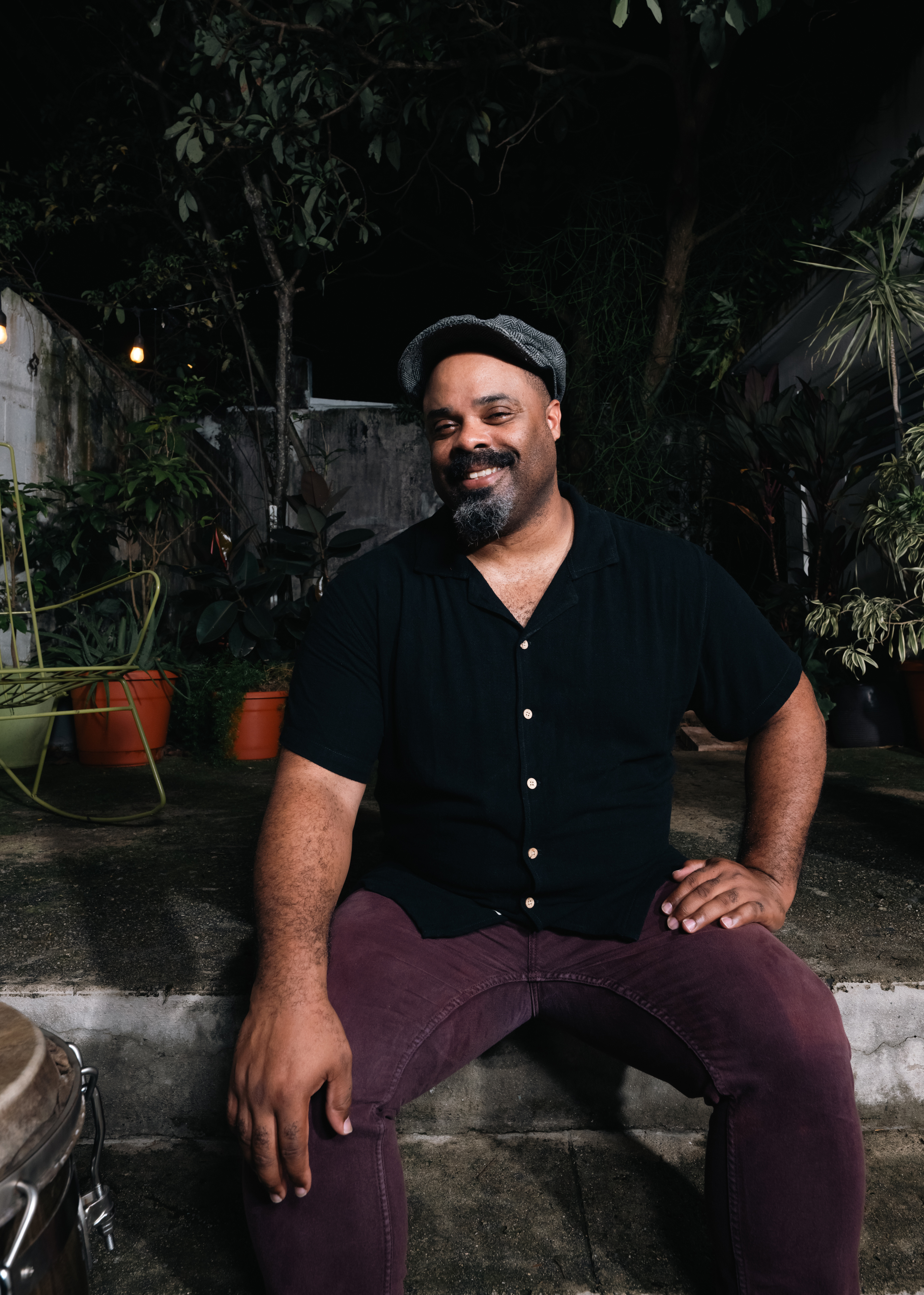 Percussionist, composer, and bandleader Hector “Coco” Barez has performed with major acts such as Calle 13, Don Omar, and Shakira before launching his 14-piece band El Laberinto del Coco (Coco’s Maze). He says he wondered, “Why don’t people dare to make a whole Bomba album? So, we did.” (Photo by Alex Diaz courtesy of Live Arts Miami)
And yet, the result, firmly anchored on bomba y plena rhythms, is an astonishing mix of driving powerhouse drumming, daring horns and brass arrangements drawing from jazz and R&B, rock guitars, and strong vocals. There had been few attempts at exploring the possibilities of bomba and plena with a large ensemble, more ambitious or successful. A generation of Puerto Rican jazz artists, including Cepeda, saxophonist Miguel Zenon, and saxophonist David Sánchez, have called attention, each in his style, live and on record, to the riches in traditional Puerto Rican music. Barez´s album evokes the sound and vision of percussionist and bandleader Rafael Cortijo’s 1973 masterwork, Cortijo y Su Máquina del Tiempo (Cortijo and His Time Machine).
 In fact, while keeping an ear on the tradition, Barez is not afraid of expanding the reach of bomba y plena, drawing from a broad variety of sources.
“Bomba led me to play rumba, flamenco, Brazilian music, but as a composer, I try to build everything around the bomba as the foundation,” he says. Since his debut album, Barez has released a follow-up EP and several singles. In his work, the fusions often sound lived-in and organic. “Bombuleria,” a track from his first album, serves as an example. It blends seamlessly sica, one of the most popular rhythms of bomba, and buleria, a style of flamenco. In that track, “you have a bulería playing out intact, and you have a sica, which is also a binary rhythm, intact,” he notes. “So you have two branches, both true, and working in harmony.”
He notes that the musical exploration and discoveries while touring throughout Latin America with Calle 13 (he recorded and toured with four of their Grammy-winning albums) were profoundly influential to his approach.
“It happened organically,” he says. “Because of Puerto Rico’s political status, we were taught almost our entire lives to look north, never south. Why? We have more affinity with the south, with Latin America. We speak the same language, we have very similar cultures,” he continues. “You have no idea how curious we were at that time about the folk rhythms in every place we were visiting. If we were going to Colombia, we would look for bullerengue, vallenato, cumbia, champeta. We wanted to learn everything.” The results were often in plain view as the duo was fearless, taking their music this way and that, into tango, cumbia, or bossa nova. Barez offers as an example “La Perla,” a song from their third album, Los de Atrás Vienen Conmigo. The track, featuring Ruben Blades, is anchored by a pulse of candombe, an Afro-Uruguayan genre that plays like a cousin of bomba.
“It shouldn’t surprise us, everything comes from the same place,” says Barez.
Historians date the African-rooted bomba to the 15th Century. It emerged along the coastal region and sugar cane fields of Puerto Rico. It features a call-and-response between the lead singer and the group, and a musical conversation between the lead dancer and the lead drummer. The quintessential instruments are the barriles de bomba (the bomba barrels), built from rum storage barrels topped with a goatskin head. The lead drum, called primo or subidor, dialogues with the dancer; one or two buleador drums, which keep the steady pulse, and the cuá, a small, hollow wooden barrel open at both ends, played with wooden sticks, that plays complementary rhythms.
Plena, another primary Afro-Puerto Rican genre, originated in the early 20th Century as work songs. It features prominently three tambourines, and because of the storytelling in its lyrics, it has been described as “a sung newspaper.”
But despite their power and depth, these Puerto Rican genres were long overshadowed in the popular music marketplace by Afro-Cuban music in its various manifestations, including salsa.
“The initial spark for me was not hearing Bomba on the radio,” says Barez. “Why don’t people dare to make a whole Bomba album? So, we did. We wanted to show this music’s roots, its evolution, and what it can be.”
While Barez is working his innovations within an old tradition, rapper Marti is giving hip hop a Miami accent. He calls his music Caribbean hip-hop.
Born in Miami into a Cuban immigrant family, Marti (aka Mario Obregon) grew up “listening to all sorts of music, but just gravitated to hip hop. I just fell in love with it.” He was especially moved by Tupac Shakur. “I was young, I didn’t know about the specific issues and things he was talking about, but I just felt something, and at that age, it’s just about feelings.”

Born and raised in Miami, Marti (aka Mario Obregon), captured performing at the Carnaval on the Mile, Coral Gables, grew up “listening to all sorts of music, but just gravitated to hip hop. I just fell in love with it.” Photo courtesy of Live Arts Miami
He grew up hearing stories about Cuba from his parents, his grandfather, and, this being Miami, his friends and their families. Tupac’s was “a completely different story,” he says. “Still, it was just a perfect blend of the hip-hop that I loved, plus stories of what was going on in his neighborhood, with his people, and bringing it to people like me who had no idea what they go through.”
It became a model for his songwriting — and it led to fundamental discoveries.
“I learned that the majority of people are going through the same things,” he says. “Even if it’s not the exact same way, and they gravitate towards something real, not made-up stories.”
Marti studied classical piano, then bass, and freestyling for fun with his friend Christian Martinez, at the time an audio engineering student, led to creating a band. “A drunk night led to an obsession that I can’t get rid of,” he jokes with mock frustration. That group became Problem Kids, which was very active in the Miami live music scene and released two albums. Then COVID hit. “It kind of forced us to do music on our own — and that’s when my solo project started taking off.”
Since, Marti has released the EPs Whispers From a Muse, (2024) and Luck Is for Losers” (2025), several singles, and created “Break Bread,” an original music video series featuring freestyle performances shot around groups and families dining at local eateries such as Tropical Chinese, Versailles, and Ariete.
“My music was born from what I was raised on, and it just morphed into what it is today,” he says. “It’s Miami, with many different types of sounds and rhythms and the storytelling of hip hop.”
An edited version of this story was posted on ArtburstMiami.com on July 11, 2025
 Jazz With an Accent