• Home
  • About
  • Contact

Jazz With an Accent

~ Global music in the 21st century

Jazz With an Accent

Author Archives: Fernando González

Recordings: Bandoneón and tango, with an accent

08 Tuesday Jul 2014

Posted by Fernando González in Jazz, Latin Jazz, On Music

≈ Leave a comment

El Valle de la Infancia
The Dino Saluzzi Group
(ECM)

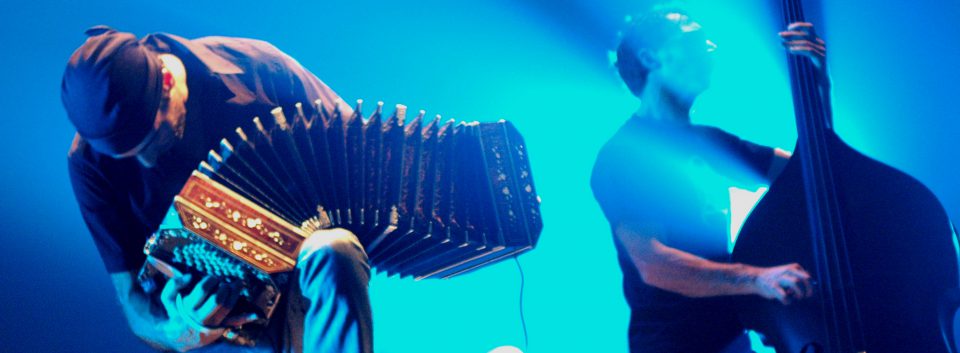
The bandoneón, a button squeezebox, might have been born in Germany as a poor man’s harmonium for religious services, but found its calling, and reached global recognition, in tango, in Buenos Aires, Argentina, half a world away. But bandoneonist Dino Saluzzi was born in a dusty small town in Salta, in Argentina’s Northwest, not the big city; and he first heard the bandoneón in folk music not tango. Naturally, and especially early in his career, in the late 60s’early 70s, Saluzzi brought the instrument to his folk music projects. And even as he later earned his tango credentials playing in classic tango orchestras in Buenos Aires, his approach to the bandoneón has always had a distinct, personal accent.

In his own music, Saluzzi has long since developed a style in which he has blurred the lines between European classical music and jazz — with a tango and folk tinge.

On El Valle de la Infancia (The Valley of My Childhood), Saluzzi, 79, comes full circle, taking stock on his musical history through the filter of the styles that have since marked him.

As it probably couldn’t have been otherwise, El Valle de la Infancia is a family affair. His sextet includes his brother Félix on sax, his son José María on guitar and his nephew Matías on bass. (Nicolás “Colacho” Brizuela, guitar; and Quintino Cinalli, drums and percussion complete the group.)

Both as a composer and improviser, Saluzzi has a particular way of setting and telling his stories. He establishes the mood with a few bold strokes, and then, more often than not, lets the themes emerge, digressing unhurriedly, adding a point here, a change-of-pace detail there as the tale unfolds.

“La Polvareda” wanders off from a near religious mood into a festive folk tune and out again. “A Mi Padre y a Mi Hijo” turns unexpectedly into a modern tango that suggests a salute to Astor Piazzolla before dissolving and reappearing as an old-style milonga. The music is not necessarily thru-composed but, for the most part eschews the standard forms. In fact, except for four of the 16 tracks, Saluzzi sets the program as a collection of suites. The connecting thread might not always sound obvious at first listening. In “Pueblo” the three pieces are each from a different composer — and he is none of them. And Saluzzi not only invokes certain traditional folk rhythms (such as in “Charqui” which draws from the folk music of Argentina’s Northwest) but also includes songs by master folk composers such as Atahualpa Yupanqui and Ariel Ramirez.

El Valle de la Infancia suggests the work of a master in winter, still looking ahead as he glances back.

In The Key of Tango
Carlos Franzetti
(Sunnyside)

Argentine-born pianist, composer and arranger Carlos Franzetti’s career defies easy labels. He has recorded jazz, tango and pop, has written chamber and symphonic music, operas and film scores, collaborated with jazz musicians, pop artists and rockers. Two recent projects, In The Key of Tango and Panamanian singer and songwriter Rubén Blades´ Tangos, brings him back to his musical roots and the results are impressive.

On In The Key of Tango, a solo piano outing, Franzetti revisits a repertory of classics, including Carlos Gardel’s “Soledad,” Virgilio Expósito’s “Naranjo en Flor” and Astor Piazzolla’s “Adiós Nonino,” as well as his own “Tango Fatal,” the title piece form his 2000 ballet.

It might sound like a simple, even natural task. But being bilingual means, inevitably, to lose some of the turns, nuances and accents of the original language. That, remarkably, is not the case here.

Old school jazz players talk about the need to know the lyrics to properly play and improvise over a song. On In The Key of Tango one can almost hear Franzetti singing along, coming to the precise pause, adding a baroque touch of flair, playing on the drama of certain phrase, speeding up and slowing down like a good club dancer. And he brings to his interpretations not only his substantial technique as a player but an arranger´s ear — now staying simple and direct, now being melodramatic, now suggesting orchestral accents (orquesta típica accents) as needed.

In The Key of Tango is not only a terrific addition to Franzetti´s discography but it makes for a smart entry point to the classic tango repertoire.

Tangos
Rubén Blades
(Sunnyside)

Recorded in Buenos Aires and New Jersey and featuring the great bandoneón master Leopoldo Federico and his orchestra, a United States-based sextet and The City of Prague Symphony Orchestra, Rubén Blades´ Tangos is a very different tango project.

Here the repertoire is comprised by Blades´s salsa classics such as “Paula C,” “Pablo Pueblo,” and “Pedro Najava,” and the challenge, for both, singer and arranger, was to re-create them as tangos.

Set with a jeweler’s touch by Franzetti’s arranging, Blades’ singing, for the most part, works. No, he doesn’t have a tango voice nor the phrasing. But, bringing to bear his experience as an actor, Blades sings with flair, trusts the words (and why not? He is one of the prime storytellers in Afro-Caribbean music) and doles out the drama judiciously.

For the most part, Franzetti sets the songs in a neo traditional tango orchestra style and it works — and his re-imagining “Pedro Navaja” and “Adán García” as sui-generi milongas works particularly well.
Probably not for tango purists, but a contribution to the genre nonetheless

July 2014, International Review of Music / Jazz With An Accent

Share this:

  • Share on Facebook (Opens in new window) Facebook
  • Share on X (Opens in new window) X
  • Email a link to a friend (Opens in new window) Email
  • Share on LinkedIn (Opens in new window) LinkedIn
Like Loading...

The joys of jazz , revisited

20 Wednesday Jun 2012

Posted by Fernando González in Jazz, On Music

≈ Leave a comment

If their recent show in Coral Gables, Florida, was any indication, and you love jazz, you need to hear the Preservation Hall Jazz Band live.
You might dismiss it, as I once did, foolishly, as just a repertory band, a sort of charming, rolling live museum act evoking what might-have-been. And there might be some of that. But with the Preservation Hall Jazz Band you also get the joy of jazz, smart, angst-free jazz, played with great professionalism but also with pleasure and a sense of humor (watching sousaphone player Ronell Johnson march in place, bob, weave and turn all the way through the performance was part of my enjoyment that night).

The music was soulful and swung forcefully yet with a casual grace of a conversation among old friends, counterlines seem to grow along, curling like vines around the main melody. It was both sturdy and lithe, complex yet appealing. The ensemble played what it must, but the audience clearly felt invited in. I suspect jazz gained a few more believers that night. Having fun is an undervalued concept in jazz — and the music has paid dearly for it. But the Preservation Hall Jazz Band taught a master class in jazz disguised as a good-time show. That’s an art in itself — and jazz has had some great practitioners. (Dizzy is a prime example of the genius disguised as entertainer).

Obviously, not every style in jazz lends itself easily to this approach. But by definition, jazz will always live in that netherworld between art music and entertainment. It’s both a weakness and a source of strength. And to have a place in the cultural marketplace, jazz needs to connect with audiences, be it in the composition, the playing or the presentation.

It played out vividly before me at that show by The Preservation Hall Jazz Band, an ensemble created 50 years ago precisely to evoke the very roots of jazz — in substance and form.

No, the challenge is not new, but the urgency is — or we can look at classical music and see the future of jazz.

June 2012, The International Review of Music / Jazz With an Accent

(photo credit Shannon Brinkman)

Share this:

  • Share on Facebook (Opens in new window) Facebook
  • Share on X (Opens in new window) X
  • Email a link to a friend (Opens in new window) Email
  • Share on LinkedIn (Opens in new window) LinkedIn
Like Loading...

(Twitter) music to my ears

30 Wednesday May 2012

Posted by Fernando González in On Music

≈ Leave a comment

A couple of weeks ago I had the chance to hear the David Sanchez Quartet with Stefon Harris in concert. It was, by any reasonable jazz standard, a beautiful performance. The music, for the most part originals, was compelling and nicely designed. The group worked like a chamber ensemble, eschewing look-at-me posturing to actually listen to each other and maintain the music front and center. And when the players did solo, they did it with imagination and eloquence.

What troubled me about the performance had to do with technology, the Internet and my brain.

As a music journalist/critic, I am a sort of professional listener. Moreover, I was educated as a musician. I was once a professional player and composer. And yet that Saturday evening, at times, I found myself lost. Worse yet, I found myself getting impatient with the length of a piece or a particular solo. The concert had a break (at the request of the promoter, explained Sanchez) and yet it felt to me like a marathon.
The audience — I’d estimate the average age in the mid-50s — listened politely and applauded at the expected moments, neither particularly engaged, nor actively disapproving.
Perhaps most, if not all, of my issues that night might be chalked up to my own deficiencies and that’s that. Then again, if it didn’t engage me, well, it didn’t engage me. Perhaps the concert was not as good as I thought. Perhaps.
But the experience was also a personal reminder of how technology is re-wiring our brains.

“We shape our tools and afterwards our tools shape us,” wrote Marshall McLuhan in his seminal Understanding Media.
Instruments such as Google, tablets and smart phones are profoundly affecting the way we read, look, listen, think and even use our memory. And they do it in ways we are not even aware of. (Quick, write down the phone numbers of three close friends or family members. I thought so.)
“I can’t read War and Peace anymore. I’ve lost the ability to do that. Even blog posts of more than three or four paragraphs are too much to absorb. I skim it,” says a pathologist on the faculty of the University of Michigan Medical School and blogger on Nicholas Carr’s The Shallows, a book on the effects of the internet on our brains.
What similar impact might our new tools might have upon our listening habits and, inevitably as a result, on the creation, performance, presentation and consuming of music?

Because, after all, as much as many look at the development of jazz with a Great Man Theory of history (say Armstrong to Ellington to Parker to Miles to Coltrane….), other, more mundane factors have played significant roles in shaping the music.
The advent of the long playing disc granted composers, arrangers and improvisers possibilities up to then unthinkable. The size of the clubs in 52nd St. might have played a greater role in the music going from big bands to small groups (and thus spurring on the development of bebop) than the talent of any one particular musician.
We should anticipate that the changes that technology continues to make to the way we process information will also have consequences.
I am not saying anything startlingly new or particularly astute here. In fact others have said it better. (The subject is brilliantly addressed by Carr in The Shallows.)

If there is a (modest) contribution to the discussion here, it is in asking how these changes are affecting our listening to music in general and jazz in particular – and how, in turn, this will shape the way music is created, designed and presented.
After all, music is an art form that happens in time and depends on memory. In the specific case of jazz, even in its most conventional format, to appreciate the reinterpretation and commentary suggested by the improvisation, the listener must be able to have some recall of the original material. Otherwise, it’s gibberish or some form of musical gymnastics.

In other words, as our memory withers, replaced by gadgets, and our attention span gets shorter and shorter, will there be in a few years an audience capable of remembering an eight-bar-theme that happened five, 10 minutes earlier? And if the listeners are not able to recall even the most basic theme, or lack the patience and discipline to connect the dots over a simple musical form, what could they then make of an improvisation? (Or in classical music: What happens with Bruckner or Mahler?)

And as audiences inevitably get increasingly lost and frustrated and impatient, go looking for something shorter and simpler, what can the composers, improvisers and presenters do? In all fairness, is there anything they should do?
On that Saturday night, a couple of weeks ago, David Sanchez and his group played a concert that at times had me baffled and irritated because, well, it had no hyperlinks, no keywords, no way to skim over and get faster to the good parts.
What did they expect?

Come to think of it, what do we expect?

May 2012, The International Review of Music / Jazz With An Accent

Share this:

  • Share on Facebook (Opens in new window) Facebook
  • Share on X (Opens in new window) X
  • Email a link to a friend (Opens in new window) Email
  • Share on LinkedIn (Opens in new window) LinkedIn
Like Loading...
← Older posts
Newer posts →

Search

Categories

  • Home
  • In Other Words
  • On Music
    • Jazz
    • Latin Jazz

Recent Posts

  • Traditions renewed: A Bomba y Plena big band and Caribbean hip-hop with a Miami accent.
  • “¡Viva La Parranda!” Music, stories, wisdom, and soup from a small Venezuelan town
  • Cortadito and the Sound of Son: from Cuba and Miami to the World

Archives

  • July 2025
  • April 2025
  • January 2025
  • November 2024
  • October 2024
  • September 2024
  • August 2024
  • July 2024
  • June 2024
  • May 2024
  • March 2024
  • February 2024
  • June 2023
  • May 2023
  • April 2023
  • February 2023
  • December 2022
  • November 2022
  • September 2022
  • June 2022
  • April 2022
  • March 2022
  • January 2022
  • December 2021
  • November 2021
  • September 2021
  • August 2021
  • March 2021
  • February 2021
  • January 2021
  • July 2020
  • June 2020
  • May 2020
  • April 2020
  • March 2020
  • February 2020
  • January 2020
  • December 2019
  • November 2019
  • October 2019
  • September 2019
  • July 2019
  • June 2019
  • May 2019
  • April 2019
  • March 2019
  • February 2019
  • November 2018
  • October 2018
  • September 2018
  • August 2018
  • July 2018
  • June 2018
  • May 2018
  • April 2018
  • March 2018
  • February 2018
  • October 2017
  • June 2017
  • May 2017
  • April 2017
  • March 2017
  • February 2017
  • January 2017
  • October 2016
  • May 2016
  • April 2016
  • March 2016
  • February 2016
  • January 2016
  • November 2015
  • October 2015
  • September 2015
  • June 2015
  • May 2015
  • April 2015
  • January 2015
  • October 2014
  • September 2014
  • August 2014
  • July 2014
  • June 2012
  • May 2012
  • December 2011
  • September 2011
  • August 2011
  • May 2011
  • December 2009
  • September 2009
  • December 2007
  • January 2001
  • September 1995
  • December 1994
  • November 1987

Archives

  • July 2025
  • April 2025
  • January 2025
  • November 2024
  • October 2024
  • September 2024
  • August 2024
  • July 2024
  • June 2024
  • May 2024
  • March 2024
  • February 2024
  • June 2023
  • May 2023
  • April 2023
  • February 2023
  • December 2022
  • November 2022
  • September 2022
  • June 2022
  • April 2022
  • March 2022
  • January 2022
  • December 2021
  • November 2021
  • September 2021
  • August 2021
  • March 2021
  • February 2021
  • January 2021
  • July 2020
  • June 2020
  • May 2020
  • April 2020
  • March 2020
  • February 2020
  • January 2020
  • December 2019
  • November 2019
  • October 2019
  • September 2019
  • July 2019
  • June 2019
  • May 2019
  • April 2019
  • March 2019
  • February 2019
  • November 2018
  • October 2018
  • September 2018
  • August 2018
  • July 2018
  • June 2018
  • May 2018
  • April 2018
  • March 2018
  • February 2018
  • October 2017
  • June 2017
  • May 2017
  • April 2017
  • March 2017
  • February 2017
  • January 2017
  • October 2016
  • May 2016
  • April 2016
  • March 2016
  • February 2016
  • January 2016
  • November 2015
  • October 2015
  • September 2015
  • June 2015
  • May 2015
  • April 2015
  • January 2015
  • October 2014
  • September 2014
  • August 2014
  • July 2014
  • June 2012
  • May 2012
  • December 2011
  • September 2011
  • August 2011
  • May 2011
  • December 2009
  • September 2009
  • December 2007
  • January 2001
  • September 1995
  • December 1994
  • November 1987

RECENT TWEETS

Tweets by FergonzMIA

Categories

  • Home
  • In Other Words
  • On Music
    • Jazz
    • Latin Jazz

Archives

CONTACT INFO

P.O. Box 402702 Miami Beach FL 33140 - 0702 USA fernando@fgonow.com

Blog at WordPress.com.

  • Subscribe Subscribed
    • Jazz With an Accent
    • Join 31 other subscribers
    • Already have a WordPress.com account? Log in now.
    • Jazz With an Accent
    • Subscribe Subscribed
    • Sign up
    • Log in
    • Report this content
    • View site in Reader
    • Manage subscriptions
    • Collapse this bar
%d