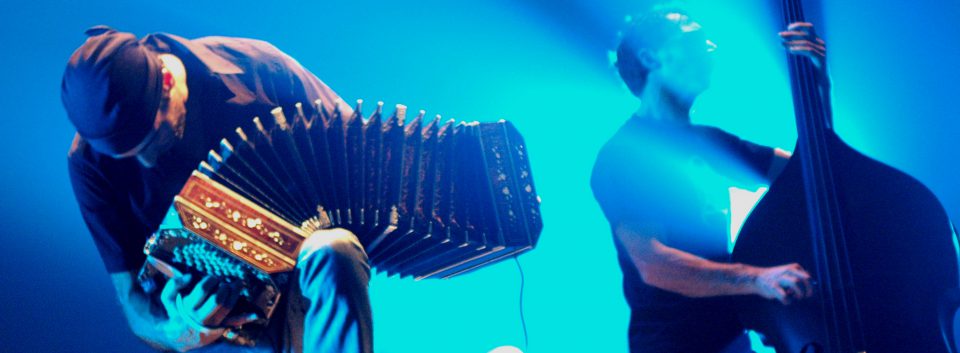

Pianist Rolando Luna with Felipe Lamoglia, sax, Jose Armando Gola, bass, and Jonathan Joseph, drums, at Miami-Dade Auditorium, Saturday, part of Global Cuba Fest 2024 Photo Fernando Gonzalez ©
The performances by Cuban pianists Ernan López Nussa and Rolando Luna and their groups at Miami Dade Auditorium on Saturday were an at times impressive but ultimately unsatisfying bookend to this year’s Global Cuba Fest, which opened with a concert by pianist Omar Sosa the previous weekend.
López Nussa, who is in his mid-60s, has blended formal classical training, a passion for jazz, and Cuban music into an original and organic style. His distinguished career includes being part of landmark fusion groups such as Afrocuba and Cuarto Espacio and also accompanying singer-songwriter Silvio Rodríguez. Since then, he has had a notable solo career. Luna, in his mid-40s, came relatively late to the piano, having studied guitar before “discovering” the instrument. He made up for lost time in a hurry. He mixed formal piano schooling and a bandstand education that included substantial stints with singer Omara Portuondo, the Buena Vista Social Club, and salsa star Isaac Delgado. Just for good measure, in 2007, Luna won the jazz competition at the Montreux Jazz Festival.
Both are capable of lightning-fast single-note runs, turn-on-a-dime rhythmic and harmonic developments, and slyly quote “The Star Spangled Banner” and “El Manisero” on the fly or use George Shearing, Maria Teresa Vera, Debussy, The Bee Gees, or, in the case of López Nussa, Bach, and Chopin, as the take-off point for their variations (López Nussa called them his musical “interventions”). Along the way, they colored every picture and filled every space.
But that you can do all that doesn’t mean you should do all that.
It might dazzle some people at first, but the approach inevitably brings diminishing returns — which is what happened on Saturday.
The difference between a good player and an exceptional artist is often measured not by what they play but by what they choose not to play.
The right silence at the right time can speak volumes — and so can its absence.

 Jazz With an Accent