• Home
  • About
  • Contact

Jazz With an Accent

~ Global music in the 21st century

Jazz With an Accent

Category Archives: Latin Jazz

The Great (Latin) American Songbook

16 Wednesday Sep 2009

Posted by Fernando González in Jazz, Latin Jazz, On Music

≈ Leave a comment

As singer Claudia Acuña launched into her first song at her concert at Festival Miami at the University of Miami, in Coral Gables, FL, a few weeks ago, her group´s swing, her own ease at coiling and releasing the melody, even her body language, all said jazz. But the words were in Spanish, and the song, “Gracias a la Vida” by Chilean singer-songwriter Violeta Parra, was no jazz standard but a modern classic of Latin American folk music.

To those familiar with the original song, the juxtaposition brought smiles and a few  “Can you do that to that song?” looks.

To those who weren’t, this was simply jazz with an accent.

But for all of us at that show that night, it was also a glimpse into a world of possibilities.

Acuña is part of a younger generation of Latin jazz performers, composers and arrangers that continues to expand and  re-define Latin jazz by exploring the home-grown music styles of their native cultures with the tools, practices, and sensibilities of jazz. As they do, they are also growing the vocabulary of jazz by including not only indigenous rhythms and, sometimes, instruments, but also their own standards, songs that are part of what can be called the Great Latin American Songbook.

Consider Panamanian pianist Danilo Perez´s takes on Ariel Ramirez’s “Alfonsina y el Mar,” or Silvio Rodriguez’s “Rabo de Nube;” Argentine trumpeter Diego Urcola’s version of tango icon Carlos Gardel’s “El Dia Que Me Quieras,”  Venezuelan pianist Ed Simon’s reworking of  Simon Diaz’s hit “Caballo Viejo,” or  Acuña herself, including songs like Djavan’s “Oceano” and Parra’s “Volver a los 17,”  alongside traditional jazz standards and her own originals.

Latin songs have been part of the jazz repertoire – from boleros such as “Cuando Vuelva a Tu Lado”  (“What a Difference a Day Makes”), and Consuelo Velázquez’s “Bésame Mucho,” to Antonio Carlos Jobim’s classic bossa novas. And some artists have began to discover this Pan-Latin repertoire. Charlie Haden has been a pioneer at it for reasons both musical and ideological. But there have been others, including pianist Bobo Stenson (“Alfonsina y el Mar,” “Chiquilín de Bachin”), saxophonist Charles Lloyd (“Rabo de Nube”), and guitarist Al DiMeola (the music by New Tango master Astor Piazzolla, including “Libertango,” and “Adios Nonino.”)

Still, what this Latin jazz movement is bringing along, musically and perhaps commercially, goes beyond  the chance to find the next novelty song or add the exotic touch..

Songs become standards for many reasons, some are strictly musical (such as their harmonic and melodic possibilities), some, for lack of a better word, are social. The popularity of a song creates familiarity and that provides artists and audiences with a shared language. Or perhaps a particular tune has a social or political message. (An appeal to our childhood’s memories with “Someday My Prince Will Come;” an appeal to our conscience with “Strange Fruit.”)

The broad Pan-Latin repertoire still coming into view offers all of the above, and more.

For starters, there is a musical wealth there – rhythmically, harmonically, melodically and texturally — that deserves a closer look. (Lyrics in Spanish are a battle for another day) And just as intriguing, the way these artists are operating on these songs, often coming closer to re-composition than arranging, is opening new ways to re-conceptualize both, the Latin repertoire and jazz standards.

Consider, for example, Argentine pianist Adrián Iaies, whose work includes both tango treatments of jazz standards (such as “Round Midnight,” and “Nefertiti” ) and jazz reworkings of tango classics.

There is no improvisation, in the jazz sense, in tango. Still, Iaies suggested, “tango is the popular music form closest to jazz, not only because of its origins – it’s rooted in black people’s music plus European [music] elements — but because the harmonic structure of a tango is similar to that of a standard.”

“Think of [tango classic] ‘Los Mareados.’ The intro, which is beautiful, is already a standard. Someone like Keith Jarrett would play half an hour over that — and then he’d still have a section in a minor key and a section in major to work with. In tango you have sections in minor and major tonalities so you can actually tell two different stories, so when it comes to improvising you can set up different things. “

Conversely, he added, “any minor key [jazz] standard can be a tango. ‘Yesterdays,’ or ‘Alone Together,’ are tangos. They just forgot to write the lyrics. ‘Blame it on my youth,’ is a tango. ‘You and the night and the music,’ for me has always been a tango. [Monk’s] ‘Reflections’ has certain chromatic things that come very close to tango.”

As for the audiences, the reactions in the faces of some of the people in the audience at Acuña´s concert in Miami told the story. Many of them had never heard those songs played that way. They might have not have known that Acuña was doing her own version of  “Come Sunday” — but they certainly got what she was trying to do with Victor Jara’s “Te Recuerdo, Amanda.”  And now they were curious, edging forward in their seats. So this is jazz, too? What else you’ve got?

Which brings up another intriguing point: this repertoire comes with its own, large, ready-made audience, a potential new audience for jazz, perhaps unfamiliar with the jazz tradition, but certainly aware of these songs. And wasn’t reaching this kind of listeners part of the idea behind Coltrane picking “My Favorite Things” or  Miles playing “Human Nature”?

I don’t expect “Alfonsina” to become a standard – not yet. But given the demographic trends in this country (and the United States is already one of the largest Spanish-speaking countries in the world) and an untapped audience to the South, wouldn’t it make sense to at least explore this repertoire? As a jazz artist, what do you have to lose? Especially considering that the standard jazz book is past overdue for updating and renewal and even serious jazz artists keep trying and hoping that covers of  songs by Joni Mitchell, Nirvana, The Flaming Lips, and Nick Drake, do the trick.

Yes, as I’ve been reminded over and over, the great obstacle for any of these great Latin songs to be brought into the standard repertoire is that most North American jazz musicians simply are not familiar with them. Fair enough.

If that’s the case, let me suggest that they might consider doing what their Latin counterparts have done, and still do, about the music in The Great American Songbook: Ask, listen and learn.

September 2009, Jazz Times
Like Loading...

One-Note ‘Jazz’ Goes Flat Without A Latin Beat

27 Saturday Jan 2001

Posted by Fernando González in Home, Jazz, Latin Jazz, On Music

≈ Leave a comment


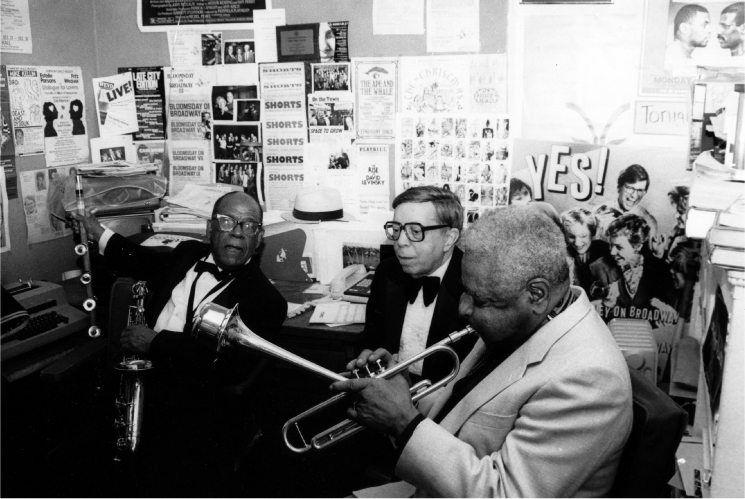
Mario Bauza (left), Marco Rizo, composer of the theme music for “I Love Lucy,” and Dizzy Gillespie; at Bauza’s 80th Anniversary Celebration at Symphony Space in Hall in 1991

This piece was published by The Washington Post on January 2001

Popular music offers a window into the society that creates it. But in “Jazz,” the 10-part, 19-hour documentary that winds up its PBS run next week, filmmaker Ken Burns peered at life in the United States through a narrow window.

He has construed jazz — and the society that created it — almost completely in terms of black and white. In the United States of “Jazz,” the Latin music and musicians who were so important to the development of this art form — and Latinos and their culture in general — barely merit a footnote.

Continue reading →

Share this:

  • Share on Facebook (Opens in new window) Facebook
  • Share on X (Opens in new window) X
  • Email a link to a friend (Opens in new window) Email
  • Share on LinkedIn (Opens in new window) LinkedIn
Like Loading...

Tom Jobim And A Legacy of Poetry in Music (An Appreciation)

11 Sunday Dec 1994

Posted by Fernando González in Home, Jazz, Latin Jazz, On Music

≈ Leave a comment


Antonio Carlos Jobim

This piece was published by The Miami Herald following Antonio Carlos Jobim´s passing, December 1994.

Brazilian composer Antonio Carlos Jobim, who died
Thursday morning in New York at age 67 of heart failure, left a
legacy of subtle power, grace and intelligence impeccably wrapped
in deceptive simplicity

Bossa nova, a style that Jobim helped create in Brazil in the late
1950s, blends poetic lyrics, folkish, seemingly willfully
naive melodies, street samba and cool jazz harmonies
into a seamless whole. The rhythms seem as often suggested as
played. The harmonies are both dense and luminous. The
performance suggests a conversation, a tale told among friends,
a secret delicately unveiled, detail by detail.
Jobim was a master at it.

His first hit in North America was “Desafinado,” in 1962.
Performed by saxophonist Stan Getz and guitarist Charlie Byrd,
it won a Grammy.

Two years later, Jobim struck again. The impact was even greater.

“The Girl From Ipanema,” performed by Getz and guitarist Joao
Gilberto, whom Jobim once credited with creating bossa nova, and
sung by Gilberto’s wife Astrud, an amateur singer who happened
to be in the studio, sparked a bossa nova craze.
His songs became American pop standards — “Chega De
Saudade” (No More Blues), “Samba De Uma Nota So” (One-Note Samba),
“Corcovado” (Quiet Nights), “Insensatez” (How Insensitive), “So Danço
Samba” (I Only Dance Samba), “Wave,” and “Aguas de Março” (Waters of
March) — were performed by artists such as Frank Sinatra, Ella
Fitzgerald and Miles Davis.
It’s unlikely best-selling pop music will ever again be this gentle.

At a time when brutality of message and language in pop is
common currency, bossa nova is a quaint anachronism. Once a
striking development, it has long become a staple of elevators,
dentist’s offices and hotel lounges.
Yet there is something elusive, even subversive at its
core.

And in Jobim, the music is a fitting reflection of the man.
“Sure, I pretend to be a simple man,” Jobim said in an
interview at his New York apartment in 1987. “I say this, and
people get furious. Maybe it is the language. In Portuguese,
pretender means something else. It means to intend, to aspire.
So I intend to be a simple man. But I also pretend to be simple,
presenting things in a simple way — but there’s always
something under the surface.”

He was born Antonio Carlos Brasileiro de Almeida Jobim in
Rio de Janeiro on Jan. 25, 1927. His father, a diplomat, died
when Jobim was 8. He had been separated from Jobim’s mother, a
schoolteacher, for five years.
His stepfather bought a piano for Helena, Jobim’s sister.
“My sister didn’t want to study piano,” Jobim said. “And I
didn’t want to. Studying piano was something for girls.”

He played in a neighborhood harmonica orchestra and also
learned guitar “just by watching” an uncle, who lived in the
house. But Jobim preferred soccer and the beach. Then he fell
into music — almost literally.

“There was no reason to leave the beach, your friends, and
go to a dark room to study piano. “E uma loucura. It’s crazy,” he
said. “Me? I fell. I fell from a human pyramid and broke my
back. Sometimes even today, my left leg goes numb. I was 18
then, and this helped me get to the damn piano. Then everything
changed. The piano became a serious business.”

He studied piano and formal composition with Hans Joachim
Koellreuter, a Schoenberg advocate who became a leader of
Brazil’s avant-garde. Years later, Jobim, who also composed
chamber music, symphonic works and film music, was still
uncomfortable at being reduced to “bossa nova songwriter.”
He actually had wanted to become an architect. He even
found a job in an architectural firm, then grew bored. He
concentrated on music and, by 1950, started playing clubs at
night. His first song was recorded in 1953. But his breakthrough
occurred when the film Black Orpheus, with music by Jobim and
Luiz Bonfa, won the Golden Palm award at the Cannes Film
Festival in 1959. (It later won an Oscar as best foreign film.)
That same year, guitarist Joao Gilberto recorded “Chega De
Saudade,” which included Jobim’s title track and “Desafinado” among
others and is still considered the Bible of bossa nova.

It shook the Brazilian pop scene.

Bossa nova — the term roughly means “the new wave”
— was cool, sophisticated and cosmopolitan, in contrast to what
some considered the hot, coarse and intensely local samba
favored by the working class. It was sung plainly and softly,
never in full voice. The melodies were nursery rhyme-like on
the surface, but devilishly chromatic up close. The harmonies
— drawing from French Impressionism via cool jazz — were
suddenly complex, subtly dissonant, full of ambiguity. The
rhythms broke the direct, simple samba beat in oblique, smaller
syncopations. It can be best described by what in Portuguese is
called balanço, a gentle swaying.

Many of the songs in bossa nova are banal meditations on
love. But Jobim, himself a writer, worked with subtle poet-
lyricists such as Vinicius de Moraes, Newton Mendonça and
Aloysio de Oliveira, and the results were often exceptional.
Sometimes, the lyrics mimic the music. In One Note Samba, the
words, playing on music and romance, state precisely what the
melody does: “Listen, here’s a little samba built on a single
note / Other notes will come soon / but the base is one note.”

Sometimes, the text determines the form. Sometimes, the parts
are indistinguishable. In “Waters of March,” the poetry, written
by Jobim, is a dazzling game of sound and meaning.

As a young man, Jobim idolized Cole Porter and George
Gershwin. He died their peer, a rare poet of pop music.

Share this:

  • Share on Facebook (Opens in new window) Facebook
  • Share on X (Opens in new window) X
  • Email a link to a friend (Opens in new window) Email
  • Share on LinkedIn (Opens in new window) LinkedIn
Like Loading...
← Older posts
Newer posts →

Search

Categories

  • Home
  • In Other Words
  • On Music
    • Jazz
    • Latin Jazz

Recent Posts

  • Ignoring Musical Borders and Embracing Discovery, The GroundUP Music Festival Celebrates Its 10th Anniversary
  • Traditions renewed: A Bomba y Plena big band and Caribbean hip-hop with a Miami accent.
  • “¡Viva La Parranda!” Music, stories, wisdom, and soup from a small Venezuelan town

Archives

  • March 2026
  • July 2025
  • April 2025
  • January 2025
  • November 2024
  • October 2024
  • September 2024
  • August 2024
  • July 2024
  • June 2024
  • May 2024
  • March 2024
  • February 2024
  • June 2023
  • May 2023
  • April 2023
  • February 2023
  • December 2022
  • November 2022
  • September 2022
  • June 2022
  • April 2022
  • March 2022
  • January 2022
  • December 2021
  • November 2021
  • September 2021
  • August 2021
  • March 2021
  • February 2021
  • January 2021
  • July 2020
  • June 2020
  • May 2020
  • April 2020
  • March 2020
  • February 2020
  • January 2020
  • December 2019
  • November 2019
  • October 2019
  • September 2019
  • July 2019
  • June 2019
  • May 2019
  • April 2019
  • March 2019
  • February 2019
  • November 2018
  • October 2018
  • September 2018
  • August 2018
  • July 2018
  • June 2018
  • May 2018
  • April 2018
  • March 2018
  • February 2018
  • October 2017
  • June 2017
  • May 2017
  • April 2017
  • March 2017
  • February 2017
  • January 2017
  • October 2016
  • May 2016
  • April 2016
  • March 2016
  • February 2016
  • January 2016
  • November 2015
  • October 2015
  • September 2015
  • June 2015
  • May 2015
  • April 2015
  • January 2015
  • October 2014
  • September 2014
  • August 2014
  • July 2014
  • June 2012
  • May 2012
  • December 2011
  • September 2011
  • August 2011
  • May 2011
  • December 2009
  • September 2009
  • December 2007
  • January 2001
  • September 1995
  • December 1994
  • November 1987

Archives

  • March 2026
  • July 2025
  • April 2025
  • January 2025
  • November 2024
  • October 2024
  • September 2024
  • August 2024
  • July 2024
  • June 2024
  • May 2024
  • March 2024
  • February 2024
  • June 2023
  • May 2023
  • April 2023
  • February 2023
  • December 2022
  • November 2022
  • September 2022
  • June 2022
  • April 2022
  • March 2022
  • January 2022
  • December 2021
  • November 2021
  • September 2021
  • August 2021
  • March 2021
  • February 2021
  • January 2021
  • July 2020
  • June 2020
  • May 2020
  • April 2020
  • March 2020
  • February 2020
  • January 2020
  • December 2019
  • November 2019
  • October 2019
  • September 2019
  • July 2019
  • June 2019
  • May 2019
  • April 2019
  • March 2019
  • February 2019
  • November 2018
  • October 2018
  • September 2018
  • August 2018
  • July 2018
  • June 2018
  • May 2018
  • April 2018
  • March 2018
  • February 2018
  • October 2017
  • June 2017
  • May 2017
  • April 2017
  • March 2017
  • February 2017
  • January 2017
  • October 2016
  • May 2016
  • April 2016
  • March 2016
  • February 2016
  • January 2016
  • November 2015
  • October 2015
  • September 2015
  • June 2015
  • May 2015
  • April 2015
  • January 2015
  • October 2014
  • September 2014
  • August 2014
  • July 2014
  • June 2012
  • May 2012
  • December 2011
  • September 2011
  • August 2011
  • May 2011
  • December 2009
  • September 2009
  • December 2007
  • January 2001
  • September 1995
  • December 1994
  • November 1987

RECENT TWEETS

Tweets by FergonzMIA

Categories

  • Home
  • In Other Words
  • On Music
    • Jazz
    • Latin Jazz

Archives

CONTACT INFO

P.O. Box 402702 Miami Beach FL 33140 - 0702 USA fernando@fgonow.com

Blog at WordPress.com.

  • Subscribe Subscribed
    • Jazz With an Accent
    • Join 31 other subscribers
    • Already have a WordPress.com account? Log in now.
    • Jazz With an Accent
    • Subscribe Subscribed
    • Sign up
    • Log in
    • Report this content
    • View site in Reader
    • Manage subscriptions
    • Collapse this bar
 

Loading Comments...
 

    %d