Don Mario Bauzá, arquitecto y director musical de Machito and his Afro-Cubans, figura crucial en la mezcla de ritmos afrocubanos y armonías de jazz y pieza indispensable en el encuentro de Dizzy Gillespie con Chano Pozo, el tema lo irritaba.
“No sé de qué hablan cuando hablan de Latin Jazz. Eso no es Latin Jazz”, decía con su inconfundible gruñido en una charla en New York en los años 80. “Nadie toca ´Latin jazz´. Eso es jazz afrocubano”. Para Bauzá, no era una cuestión de dar debido crédito. Él hablaba de un “Latin Jazz” mucho más ancho y profundo, incluyendo mucha más música del mundo Latinoamericano: joropos venezolanos, huapangos mexicanos, palos del flamenco, tango.
Una conversación entre ellos hubiera sido fascinante. Barbieri, más conocido como compositor e intérprete de la banda sonora de la controversial El Último Tango en Paris de Bernardo Bertolucci, dijo más de una vez que él no tocaba jazz. Desde ya, nunca se vio como un músico de Latin Jazz. Y sin embargo, con un puñado de discos grabados entre finales de los años 60 y mediados de los 70, Barbieri marcó un antes y después en el universo del jazz.
Habiendo hecho su punto, el maestro concedía que había excepciones.
Pero su lista de artistas en su visión del Latin Jazz era corta.
“Patria y Vida: The Power of Music” documents a song that exploded in Cuba through social media and became an anthem in historic protests. (Photo courtesy of 40th MDC’s Miami Film Festival)
The recent Miami Film Festival included three documentaries exploring some of the issues surrounding music and politics in Cuba. An edited version of this story ran as a preview in the digital magazine Artburst Miami. If you have the chance, do check them out.
* **
In the Cuba of the Revolution, culture has been an often brutally disputed battlefield. Creators make for unruly subjects and present autocrats and dictators with profound challenges and elusive targets. Guns and torture don’t do well against music.
Three films at the 40th Annual Miami Film Festival (March 3 – 12 ) offered a view of the costs of those battles for some artists — irreparable might-have-been’s, never-will-be’s, and exile — and, implicitly, for the country — but also hope.
AfroCuba ’78 tells the story of a once-promising jazz group, a never-released album, the breaking up of the original band, and the resulting scattering of some of its members.
Bebo offers a view of the life in exile in Sweden of the pianist, arranger, and bandleader Bebo Valdés, a towering figure of the Golden Age of Cuban music. In disagreement with the path of the Revolution, he left the country in 1960. He died in Sweden in 2013 without ever returning to Cuba.
Patria y Vida: The Power of Music documents the creation, impact, and consequences for those behind a song that exploded in Cuba through social media and became an anthem in the historic protests inside and outside the island on July of 2021.
For the Cuban American director and producer of AfroCuba ’78, making his film wasn’t just about documenting the music of a band.
“While I was in Cuba, I heard talk about this great group, AfroCuba. But what I heard of them at the time [as the accompanying band of singer-songwriter Silvio Rodriguez] was not that interesting to me. But it turned out this was a different AfroCuba. It included some of the musicians of the earlier AfroCuba, but that was a jazz group that had recorded a fantastic album that was never released. The band barely played in Cuba — and never played outside Cuba. Now, that piqued my interest,” says director Emilio Oscar Alcalde. “This film is about the music, but also how political manipulation and the games the system in Cuba creates destroyed a project that had the potential to be wonderful, extraordinary.”
Government suspicions about some members wanting to defect ended the chances to travel, killed the release, and created tensions within the band. The original AfroCuba, a group of young virtuosos who blended Afro-Cuban musical traditions and post-bop, came apart. Some members regrouped under the same name but became the band accompanying Rodriguez. Others indeed chose exile. “It finished them,” says Alcalde.
Bebo Valdés was a human hub in the music life of Havana in the 1940s and 50s. But in 1960, he left for Mexico under the pretext of fulfilling a non-existent contract. While on a tour of Europe, Valdés fell in love with a Swedish woman, married, and settled in Stockholm. He made do for years playing modest piano bars and hotel lounges. His story seemed destined to fade to oblivion — until he was rediscovered with the release of Bebo Rides Again, an album produced by fellow Cuban exile Paquito D’Rivera in 1994. (Besides the obvious musical reasons, there was also an almost-family relationship at play. Tito D’Rivera, Paquito’s father, was a classically trained saxophonist who played with, and was a friend of, Valdés.)
Improbably, the album sparked an unexpected second career for Valdés.
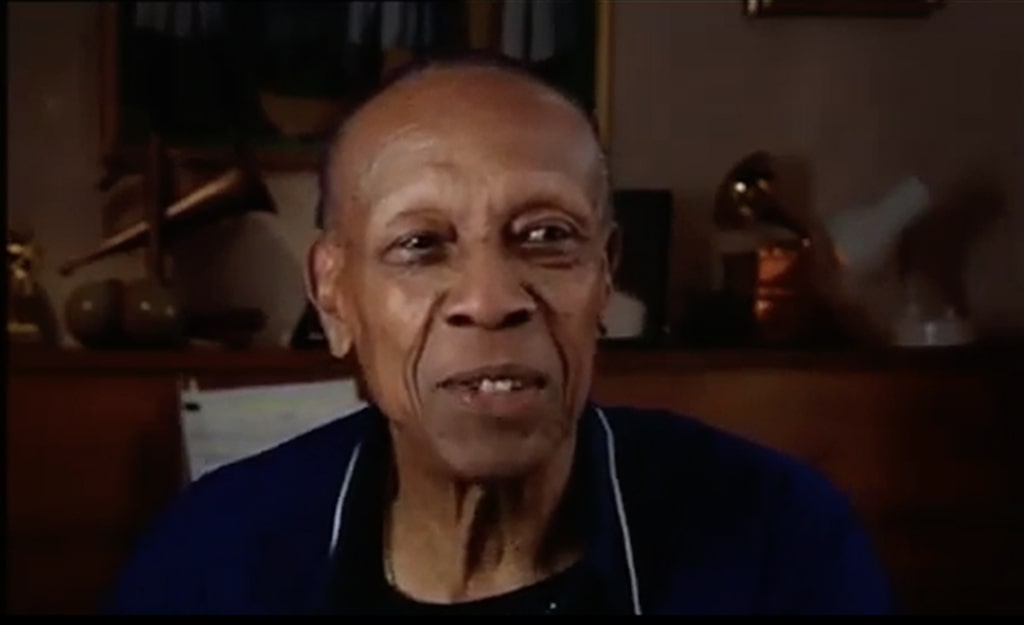
Cuban pianist, arranger, and bandleader Bebo Valdés left Cuba in self-exile in 1960. He died in Stockholm, Sweden, in 2013 having never returned to Cuba. (Photo courtesy of 40th MDC’s Miami Film Festival)
He debuted in the United States in 1996. He was 78. But by the time he retired, Valdés had collected four Grammys and five Latin Grammys.
The documentary is a glimpse of his story in Sweden. It includes footage from an interview he granted Swedish journalist Stina Dabrowski in 2005, interviews with Valdés’s Swedish sons, Raymond and Rickard, and footage from a tribute concert organized by Bebo’s grandson, Emilio Valdés, in Union City, New Jersey, in 2019.
Ultimately, however, Bebo is as much a celebration of Bebo Valdés as a meditation on resistance and life in exile.
“I’m concerned with documenting the Cuban diaspora. It’s a mission for me,” says Cuban American filmmaker Ricardo Bacallao, director of Bebo, from his home in Berlin, Germany.
“Nobody asked me to do it, but I see all of us Cubans living outside of Cuba, around the world, doing things, and it’s not being documented.”
He notes that the European press still covers the Cuban Revolution with sympathy.
“Their view seems fixated 60 years ago . . . and it’s so far from reality now, and that’s a problem. You might be a tremendous musician, but if you are a Cuban living in exile, you won’t get the kind of support that other exiles might get. There is suspicion.”
That might explain, in part, why a Cuban master musician lived for decades in Sweden, surviving at times doing menial non-music jobs unrecognized. “How Bebo lived for so long in Sweden and never got the attention he deserved is a question that is still open,” says Bacallao. “I’d like somebody to answer it.”
There is a powerful moment in Valdés’s interview when he reflects that “there are two words that must be erased: Hatred and rancor. And the other one, worse yet, vengeance. That is the vilest word there is.” For the filmmaker, the message is clear.
“This documentary is about us, Cubans living outside the island, and how hard it is to live in exile and the resistance,” he says. “I have interviews with people who knew Bebo from the 1950s, the 60s, and the 70s, and they told me about different Bebos. He was angry. This is a human being, not a superhero. But this Bebo [the Bebo Valdés in the interview] is the wise Bebo. You need certain thinking and experience to get to the point of saying: forget about resentment, frustration, and vengeance. We need to have this healing process for the good of the Cuban family.”
But before getting to that moment, some battles remain.
In Patria y Vida: The Power of Music, Beatriz Luengo, a Spanish actress making her debut as director and scriptwriter, offers a privileged view of the creation of the song “Patria y Vida” (“Fatherland and Life”), how the collective that produced it came together, and the impact of the music on both its creators and the people inside and outside Cuba.
The very title of the song flips on its head an old Revolution slogan, “Fatherland or Death,” and the lyrics include lines such as “No more lies, my people ask for liberty/ No more doctrines, let’s no longer shout Fatherland or Death, but Fatherland and Life,” or “May no more blood flow for wanting to think differently. Who told you that Cuba is yours? My Cuba belongs to all my people.”
The song also rails against the government’s attempts at censorship, such as Decree 349, which establishes that all artistic activity had to be authorized in advance by the Cuban culture ministry. “Patria y Vida” appeared painted on walls and became the slogan of the opposition in Cuba and cities around the world. Millions watched the video on YouTube.
But success came at a price. The scenes of the repression in Cuba following the people’s embrace of the song’s message are chilling and infuriating. Rapper Maykel Osorbo and visual artist Luis Manuel Otero Alcantara, who participated in the project while still living in Cuba, are now serving nine- and five-year sentences in maximum security prisons. Both are also members of the Movimiento San Isidro, a group of artists, journalists, and academics formed in 2018 to protest censorship.
The Patria y Vida collective also includes Yotuel Romero, a founder of the Paris-based hip-hop group Orishas; Alexander Delgado and Randy Malcom, who comprise the reggaeton duo Gente de Zona, composer Descemer Bueno, and rapper Eliécer Márquez “El Funky.”
Luengo is the non-Cuban insider. An artist herself, she contributed to the birth and development of the song. She’s also Romero’s wife. The global phenomenon started in the couple’s house. Romero had been thinking for a while about “how to turn the government’s symbols around,” says Luengo. A kitchen conversation about flipping the phrase Patria o Muerte, which she had seen splashed nearly everywhere while on a visit to Havana “led us to the piano in our living room, and we started.”
For Luengo, the film “is the story of a song — and the internet. They thought it would all stay between four walls because they knocked down the internet — and as soon as they turned it on again, those images were everywhere. Now if you put the hashtag Patria y Vida on the platforms, you immediately get police abuse, the pain, real people making social denunciations.”
“The Cuban government has always used art as a tool,” she says. “They have indoctrinated with music but also have been very afraid of artists. I think they have a script that they follow every time there is some artistic act they want to repress. It’s like, ‘OK Let’s say that those artists are paid by I don’t know who and I don’t know what, and we don’t know who they are.’ Well, in our case, there is also the racial element added. These are young black men, so they must be criminals.”
She chuckles as she recalls questions about the grand plan of Patria y Vida.
“There was no playlist, no marketing budget, calculation on followers, or algorithms. There just wasn’t,” she says, her words rushing with an edge of frustration. “It really began, as I believe great stories begin without a pretense. You watch the documentary and realize they had no pretenses. Their big ambition was to help get the voice of Cuba heard.”
An edited version of this story was first posted by the digital arts magazine ArtburstMiami in March 2023.
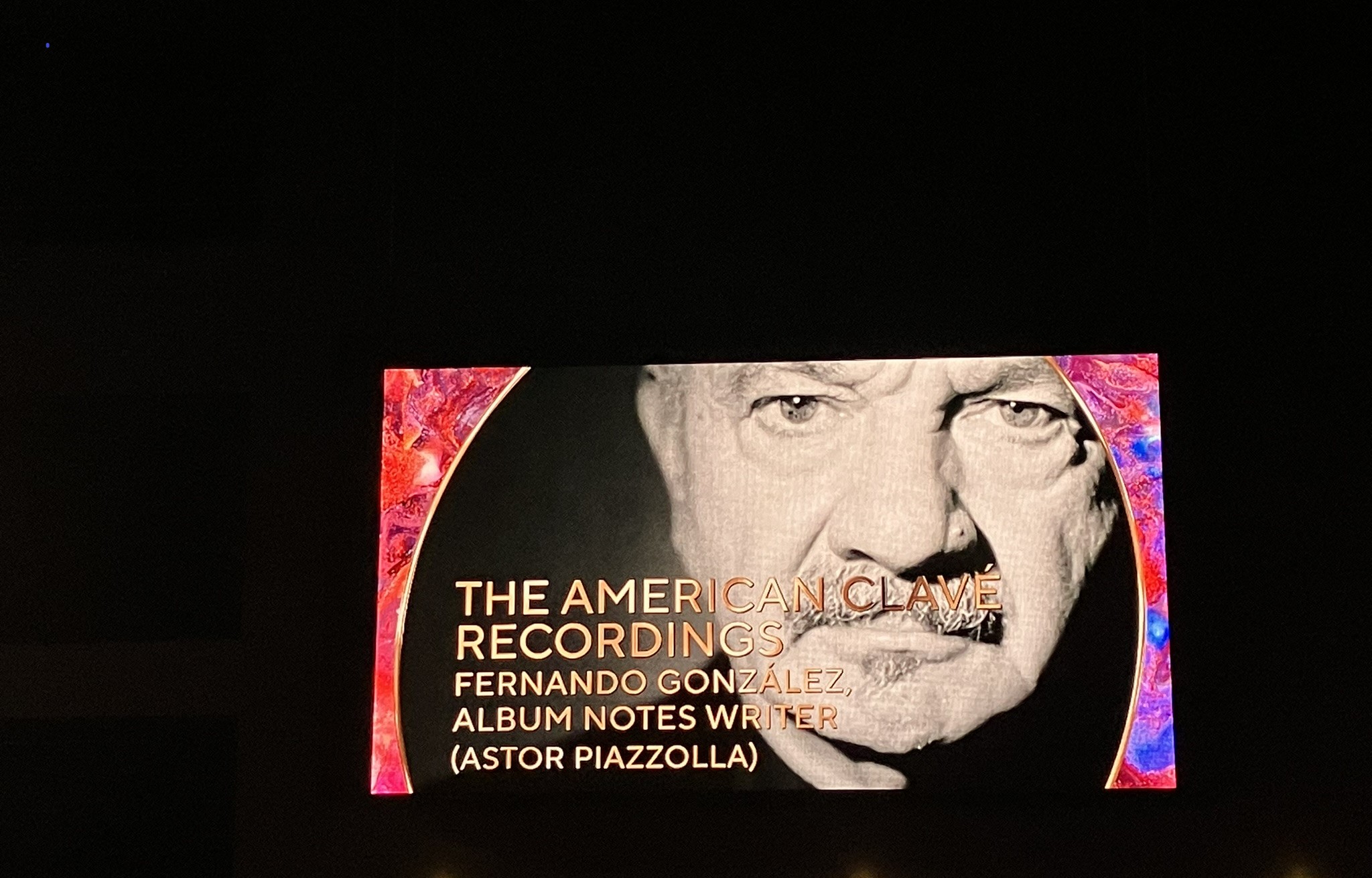
The image on the screens at the Grammy Premiere Ceremony Sunday, as the nomination was read.
Being nominated for a GRAMMY for my liner notes for Astor Piazzolla, The American Clave Recordings, his “American” trilogy, was personally meaningful. The late Astor Piazzolla was a musical hero of mine and an inspiration to become a musician while growing up in Buenos Aires. Kip Hanrahan, the brilliant producer of these recordings, is a dear friend.
Getting the nomination was quite an (unexpected) achievement. Winning was another matter. The category included truly excellent work by John Schneider (for Harry Partch, 1942), Ted Olson on Doc Watson (Life’s Work: A Retrospective), and Gareth Murphy (for Andy Irvine & Paul Brady). And congratulations to Bob Mehr for winning the Grammy for the notes for Wilco’s Yankee Hotel Foxtrot (20th Anniversary Super Deluxe Edition)
I was disappointed, of course — and my next thought was to apologize to Astor and Kip. I felt I had failed them. When I mentioned it to Kip in a message, he didn’t want to hear about it and did what friends do: he threw me a lifeline. “Nothing having to do with Astor has ever gotten a Grammy before. This is as close as we got.”
Come to think of it, I don’t believe Kip, despite the exceptional body of work he has created over the past 40 years, has received his due, either.
I take this as a win, then. This is for you, Astor, and Kip. Thank you for the music.