Pianist Fred Hersch begins a week-long of one-tune Facebook Live solo videos collectively entitled The Year That Was, which he calls “musical reflections on an extraordinary twelve months.”
The series, which starts today, runs through next Sunday, March 21st, at 1pm EDT “Each day I will be requesting donations to a different charity,” Hersch noted in his announcement.
Those interested do not have to be “on” Facebook to tune in. Go to this link
If you know the music of New Tango master Astor Piazzolla or better yet, if you are still wondering what all the noise is about, you might want to check the tribute to Piazzolla in the year of his centenary by the Koubek Center at Miami Dade College this Friday on Facebook @ KoubekCenter MDC at 8 p.m.
100 Years of Piazzolla, The Soul of New Tango, is a virtual show that features works from different periods of Piazzolla’s career, samples his film music, explores his global impact, and offers insights into the man and the composer. (Full disclosure here, I was part of the Koubek Center’s team that created and produced the program as the creative director.)
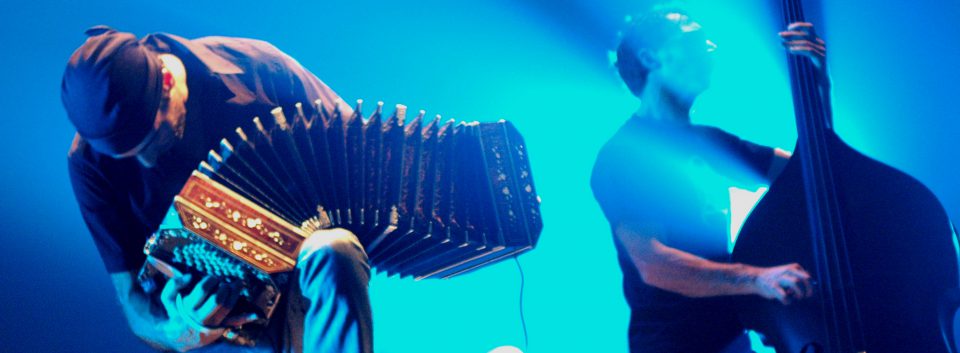
The show includes performances by the Quinteto Astor Piazzolla, of the Fundación Astor Piazzolla; bandoneon player and arranger David Alsina with a string quartet of Fellows of the New World Symphony; and bassist, arranger, and producer Pablo Aslan’s Mash-ish, an exploration of Piazzolla’s music from an intriguing perspective, featuring an Argentine/Brazilian ensemble performing from Rio de Janeiro, Buenos Aires, and Vinalhaven, ME. The program also features personal reminiscences by Miami’s bandoneonist Miguel Arrabal, who played on choreographer and director Graciela Daniele’s Broadway show Dangerous Games, music by Astor Piazzolla, who conducted the rehearsals. Finally, the show also includes a clip from the film The Years of the Shark, a biography of Piazzolla featuring rare personal material, and an interview with its director Daniel Rosenfeld.
100 Years of Piazzolla, The Soul of New Tango will be available after Friday at the Koubek Center’s YouTube channel and Facebook @KoubekCenterMDC.
Argentine composer, musician, and bandleader Astor Piazzolla, the creator of New Tango, would have celebrated his 100th birthday this March 11. He died in 1992 at the age of 71. But by then, his music — which rewrote of the rules of tango by drawing from sources as disparate as jazz, European classical music and klezmer — had made him an international figure.
Once reviled by many at home, Piazzolla attracted audiences for New Tango around the world and gained admirers and champions such as Mstislav Rostropovich, Yo-Yo Ma, Gil Evans, Al DiMeola, Gary Burton, and Grace Jones.
Also, as a student of classical music by day and a tango musician by night, the young Piazzolla had once dreamed of becoming a classical composer in the European tradition. But instead of merely emulating his predecessors, he forged a new musical genre that built on the foundation of the past. Years later, Piazzolla got to lead his ensembles in the temples of classical music, and his New Tango was played by symphonic orchestras, chambers groups, and string quartets. Being Piazzolla was enough.
Sometimes an outsider is needed to upend traditions and challenge entrenched habits — and Piazzolla, who was not born in Buenos Aires, the tango capital, but Mar del Plata, a seaside city about 248 miles south of Buenos Aires, and then grew up in the rough Lower East Side of Manhattan until the age of 17, was the perennial outsider — by fate and by choice.
He got his first bandoneon, the melancholy-sounding button squeezebox when he was nine, as a gift from his father, a tango fan. There was not a choice of bandoneon teachers in New York in the 1920s, so he made do by trying the buttons and, eventually, adapting the music by Bach and Schuman he learned from his neighborhood teachers, all pianists.
When the family returned to Argentina, he didn’t speak Spanish that well. “My mom would speak to me in Spanish, and I would answer in English,” he once told me.
Yet when Piazzolla moved to Buenos Aires, he soon found work playing and arranging for Anibal Troilo, a master bandoneonist and composer who led one of the top tango orchestras of the day. But still, in the tango world, Piazzolla was a talented oddball. And even Troilo was not enough for him musically. He started studying with classical composer Alberto Ginastera, organized his own orchestra and wrote music for film.
In 1954, when he was 33, Piazolla won a scholarship to study in Paris, France, with the fabled Nadia Boulanger, teacher of Aaron Copland, Darius Milhaud and Elliot Carter, among many others. She was lukewarm about his classical writing, but, years later, Piazzolla was still fond of recalling the scene when she asked him to play something else, whatever he did back home. A bit mortified, he started out with “Triunfal,” one of his tangos, and after a few bars she stopped him. “Now, this is Piazzolla,” she told him. “Don’t ever leave him.”
Astor Piazzolla and his great second quintet featuring Fernando Suarez Paz, violin; Pablo Ziegler, piano; Horacio Malvicino, guitar, and Hector Console, bass, performing in Japan in 1980
The blessing refocused and energized him. He returned to Argentina, and in 1955 he organized an extraordinary octet (which he claimed was inspired by hearing Gerry Mulligan’s Tentet) that marked a before and after in tango.
By looking past the dance floor and the postcard clichés of the music, Piazzolla, the man many accused of killing tango, saved it from itself.
For his New Tango, Piazzolla held on to tango’s poignancy while sidestepping its tendency toward nostalgia and self-pity. His writing was elegant and cosmopolitan but also visceral. It brought a fresh harmonic and rhythmic language to tango, with nods to jazz, Bartok and Stravinsky, soaring melodies and themes set as three-part fugues. The sum result was aggressive and lyrical, and always moving in its coarse tenderness. And while he was a master of the bandoneon, his best instrument was the quintet — a jazz-type of a group, not a traditional tango ensemble — that included piano, double bass, violin and electric guitar.
He approached his quintets as miniature orchestras, but he would also tell his musicians that the music had to have mugre, grime.
His New Tango came alive in the perfection of imperfection. Its humanity made him immortal.
Fernando González translated and annotated Astor Piazzolla “Memoirs” (as told to Natalio Gorin) Amadeus Press, 2001; and wrote liner notes for four of Piazzolla’s albums in the 1980s.
A version of this essay appeared in JAZZIZ Magazine.
Watch the virtual tribute 100 Years of Astor Piazzolla. The Soul of New Tango Facebook @KoubekCenterMDC March 12, at 8 p.m.