Jazz With an Accent Radio Playlist November 14


Jazz with an Accent logo with image of upside down globe and banner The idea has never been to offer a play-by-play of the evening’s program but some information and commentary that perhaps will deepen your enjoyment of the music you will hear and intrigue you into looking for more of it. As a host, I prefer you hear the music, not me talking.

We say that jazz has become a global language that artists around the world use to tell their stories. Sometimes that means reinterpreting the jazz tradition with the tools and ways of their musical traditions, something that continues to expand the jazz vocabulary. Sometimes they use the approach and syntax of jazz to re-imagine, perhaps re-energize, those traditions.

We’ll hear a bit of both tonight.

Thelonious Monk’s approach to rhythm and swing as a pianist and composer has been an inspiration for many Ibero-American and Caribbean artists. We’ll hear Spanish pianist Chano Domínguez turn “Bemsha Swing” into a Flamenco dance, accompanied only by taconeo (footwork) and palmas (clapping). Monk might have gotten up from the piano for that. And we’ll hear Trinidadian trumpeter and composer Etienne Charles give “Green Chimneys” a Calypso strut. It’s a track from his album Creole Soul, Charles’ celebration of folk and pop Caribbean musical traditions. Check the work on “Green Chimney” by Charles, pianist Kris Bowers and saxophonist Brian Hogans.
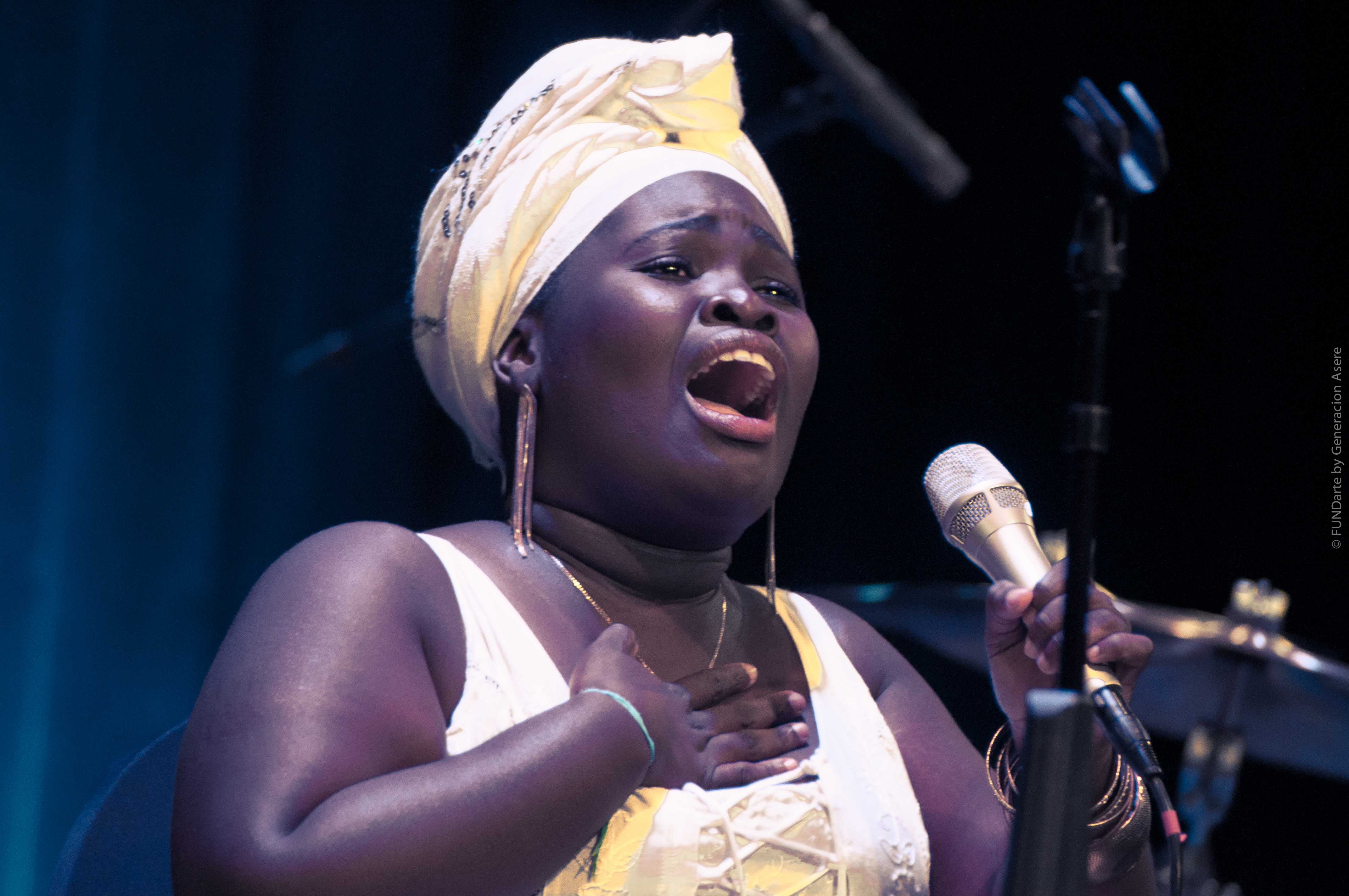
Arocena LGR GCF 2016-6The next segment has a distinct Cuban accent. Panamanian pianist Danilo Perez and his trio, featuring bassist Ben Street and drummer Adam Cruz, heard live at the Jazz Showcase in 2015, reframe Cuban singer-songwriter Silvio Rodriguez’s standard “Rabo de Nube.” Meanwhile, singer and songwriter Daymé Arocena, one of the most compelling young vocalists to emerge from Cuba in recent years, sets “Cry Me a River” as a rumba guaguancó that flows naturally into the rumba “Xiomara,” sung in Spanish, in her 2015 EP Havana Cultura Sessions.

(Daymé Arocena performing at the Miami Beach Bandshell. Photo by Tony Martinez, Fundarte)

We’ll follow “Cry Me a River” with a sly version of Consuelo Velázquez’s classic “Besame Mucho” by Afro-Argentine guitarist, multi-instrumentalist, and singer Oscar Alemán, a contemporary of Django Reinhardt and a figure in Josephine Baker’s ensemble and show. While researching for the recent String Theory program, I rediscovered tracks I hadn´t heard in some time. This features not only Alemán’s playing but a bit of cheeky singing (in Spanish) in which he curiously tweaks the lyrics. “Kiss me, kiss me a lot, as if this afternoon (instead of the original “Tonight”) were the last time,” he sings. So much for nighttime drama. (I wish I knew more about the context of this version.)

The program then picks up right on Alemán’s irreverent take on a beloved standard as British pianist, composer, and arranger Django Bates does “My Way” his way.  This song has been interpreted with great gusto by artists as disparate as Frank Sinatra, Nina Simone, the Gipsy Kings, and Sid Vicious — but Bates’ take is one of a kind. He has a special talent to, at the same time, pay homage to the piece at hand, stretch it this way and that to check for new possibilities, and mock it as needed.

There is no joking around by Venezuelan pianist Edward Simon. His urgent post-bop version of “Libertango” honors the energy of one of New Tango master Astor Piazzolla’s most popular pieces. The track is from his trio album Latin American Songbook.

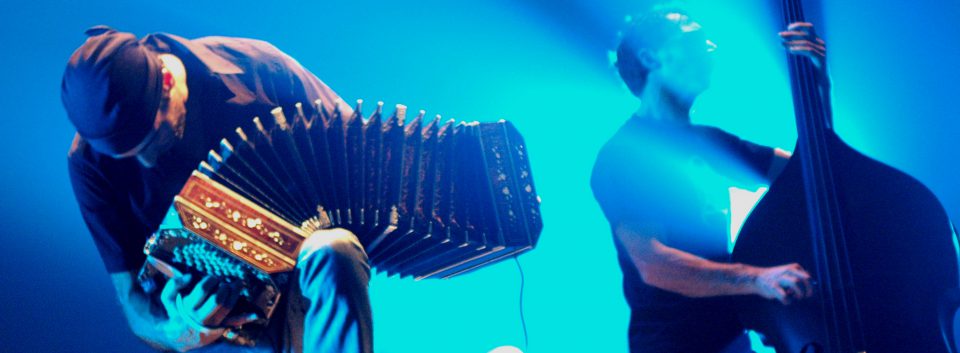
BeytelmanntrioAs a bookend for a program that started with probings of the music of Thelonious Monk, we’ll visit Duke Ellington’s legacy: “Mood Indigo” in a slow-paced, brooding version by Spanish pianist Albert Sanz and his trio, and a tango reimagining of “In a Sentimental Mood” by Argentine pianist and composer Gustavo Beytelmann, a former Piazzolla sideman and long-time Paris resident. This track is from the album Tango a la Duke, featuring a program of tango versions of Ellington’s classics by Beytelmann and his trio comprising the late Juan Jose Mosalini, bandoneón, and Roberto Tormo, double bass.

Bill Evans once said “Jazz is not a what; it’s a how,” and it’s a central idea of Jazz With an Accent.

We close with Chano Domínguez´s Flamenco-accented “Turn out the Stars.”

If you have any questions, suggestions, corrections, or requests, and you’d like to reach me, feel free to write to me at fernando@jazzwithanaccent.com

Until then, thank you for listening.

Playlist

  1. Etienne Charles                           “Green Chimneys”           Creole Soul 
  2. Chano Domínguez                       “Bemsha Swing”              Hecho a Mano      
  3. Danilo Pérez                                  “Rabo de Nube”            Live at the Jazz Showcase
  4. Dayme Arocena                           “Cry Me A River”             The Havana Culture Sessions
  5. Oscar Alemán                              “Bésame Mucho”            Grandes Exitos Vol.2
  6. Django Bates                                “My Way”                      You Live & Learn…(Apparently)
  7. Edward Simon                              “Libertango”               Latin American Songbook
  8. Albert Sanz Trio                           “Mood Indigo”             Metamorfosis
  9. Gustavo Beytelmann Trio             “In a Sentimental Mood”   Tango A La Duke 
  10. Chano Domínguez                  “Tu Enciendes Las Estrellas”  (Turn Out the Stars)    Hecho A Mano

Jazz With an Accent Radio Playlist Nov. 7

Jazz with an Accent logo with image of upside down globe and banner

This is an abbreviated posting about tonight’s program. The Jazz With an Accent crew is still suffering the effects of PESD (Post-Election Stress Disorder). We hope you and yours have survived the event well.

On to the music.

Tonight, you’ll hear another installment of Jazz With an Accent’s String Theory, with a focus on guitars, ouds, and mandolins in global jazz.

Spanish guitarist Gerardo Nuñez is a virtuoso player who sounds as comfortable playing in a traditional style as in his excursions in flamenco jazz fusion. We’ll hear the title track from his album Calima, an effort featuring Panamanian pianist Danilo Perez, John Patitucci on bass, and Armenian percusssionist Arto Tuncboyaciyan.

Then we’ll explore several variants of stringed Brazilian jazz. Alemao (Olmir Stocker) was once part of the mid-60s TV show Jovem Guarda, which featured rock-influenced pop artists such as Roberto Carlos and Erasmo Carlos, was later a member of Brazilian Octopus. This group included multi-instrumentalist, composer, and bandleader Hermeto Pascoal, and released his first album as a leader, Longe dos Olhos Perto do Coração (Far from the eyes, close to heart), in 1989.

The superb Brazilian duo comprising virtuoso mandolinist Hamilton de Holanda and pianist Andre Mehmari reimagines the possibilities in the music of Egberto Gismonti and Hermeto Pascoal in Gismontipascoal: A Musica de Egberto e Hermeto. This is demanding music, and what de Holanda and Mehmari set out to do is a high-wire act, but they have the chops to pull it off. Just hear “Frevo,” a Gismonti classic.

(Photo of Oscar Alemán. Unknown Author. Source: Wikimedia Commons)

And we’ll close the first half with a nod to a historical figure in global jazz: Afro-Argentine guitarist Oscar Alemán. He’s one of the great jazz musicians Latin America has produced, but has been largely overlooked for having committed the unfortunate mistake of being a contemporary of Django Reinhardt. (Alemán was just a year older than Reinhardt. They were friends and even played together on occasion) Reinhardt’s biographer, Michael Dregni, noted that Django was not alone in the beginnings of hot jazz and that Alemán had his own hot style. Born in Chaco, a province in the north of Argentina, Alemán moved to Europe in the late ’20s and settled in Paris, where in the 1930s he worked with Josephine Baker. Duke Ellington heard him in and offered him a job, but Alemán, just 24 at the time, was under contract, and Baker didn’t let him go. According to biographer Sergio Pujol in his Oscar Alemán La Guitarra Embrujada (Oscar Alemán The Bewitched Guitar), Baker argued that she couldn’t be expected to find overnight “a replacement who could sing in Spanish, Portuguese, French, and Italian; who could also dance […] play guitar, cavaquinho (a Portuguese small four-string guitar), pandeiro (tambourine) drums and on top of it all, be a good guy.” Alemán eventually returned to Argentina and never visited the United States.

In the second half of tonight’s show, we´ll zigzag between styles and music traditions.

OrganTrio

We´ll hear Austrian guitarist Wolfgang Muthspiel and his quintet –, featuring trumpeter Ambrose Akinmusire, pianist Brad Mehldau, Larry Grenadier, bass, and Brian Blade, drums — and then Brazilian guitarist Ricardo Silveira surprises with a marvelous throwback organ trio, featuring Canadian organist Vanessa Rodrigues on Hammond B3 and Rafael Barata, drums. Silveira’s smooth, round tone and unhurried phrasing sounds perfect for this setting. The repertoire of Organ tRio (well, it was recorded in Rio de Janeiro) includes songs from classic Brazilian composers such as Tom Jobim, Dori Caymmi, and Chico Buarque, originals, and standards. Tonight we’ll hear “Memphis Underground,” a tip of the hat to Herbie Mann, one of Silveira’s early employers during his time in the United States.

From the warm, cozy sound of this Brazilian organ trio, we’ll skip to the world of East-West musical explorations of Lebanese master oud player Rabih Abou-Khalil and hear the title track of his album Blue Camel. This is a standout recording in Abou-Khalil’s extensive discography and it features Charlie Mariano on alto sax, Kenny Wheeler on flügelhorn and trumpet, Steve Swallow on bass, and Milton Cardona on congas. On first listening, the blends and crashes of musical conceptions seem almost incompatible. But in there’s a high level musicianship at work on this album, and as the performances probe the music, the results offer unexpected surprises. This track is a good example.

In Jazz With an Accent we say there’s a world of jazz to discover. But there is not enough time to talk and play the music I’d like to share with you, and I prefer you hear the music, not me. So, if you want more information about the music and the artists, please come back and check Jazz With an Accent.com

And if you have any questions, suggestions, corrections, or requests, and you’d like to reach me, feel free to write to me at fernando@jazzwithanaccent.com

Until then, thank you for listening.

Playlist

  1. Gerardo Núñez                 “Calima”             Calima
  2. Alemao (Olmir Stocker)             “Quase Inocente”  Longe dos Ohlos 
  3. Hamilton De Holanda & André Mehmari   “Frevo”  Gismontipascoal: A Musica de Egberto e Hermeto
  4. Oscar Alemán     “Saint Louis Blues”
  5. Wolfgang Muthspiel    “Triad Song”                Rising Grace 
  6. Ricardo Silveira        “Memphis Underground”      Ricardo Silveira Organ tRio
  7. Rabih Abou-Khalil    “Blue Camel”                    Blue Camel     

Ed.Note: this story has been edited since originally posted to reflect the music that was actually played.

Jazz With an Accent Radio Playlist October 31st

Jazz with an Accent logo with image of upside down globe and banner

Tonight we´ll listen to large ensembles with an accent. It’s a narrow sampler but of excellent writing that mixes instruments and strategies of jazz with elements from the tango, flamenco, and African traditions, with touches of pop, rock, avant-garde, and European classical music.

The opening track tonight is “Buenos Aires Report” by Argentine pianist Pablo Ziegler from his album Amsterdam meets New Tango. Ziegler was, for 10 years, the pianist of Astor Piazzolla’s New Tango Quintet. He’s a classically trained musician with a love of jazz.

The first time I heard him in concert in Buenos Aires, he had a trio a la Jacques Loussier and his repertoire included classical pieces interpreted in the jazz idiom.

SONY DSC

(Photo of Pablo Ziegler by Masae Shiwa . Courtesy of the artist.)

Piazzolla had once tried his hand at jazz tango fusion, most notably on his album Take Me Dancing, recorded in New York in 1959.  At the time, Piazzolla thought it was a musical and (a potential) commercial success, but the results well, let’s call them a noble failure. He later dismissed the album as “an abomination.” So when Piazzolla called, Ziegler was surprised. “I couldn’t figure out why he wanted me,” he told me. “But what was clear was that he didn’t want a tango pianist.”

In time, Ziegler’s contribution became essential to the performance of Piazzolla’s music. But after Piazzolla dissolved the group in 1988 and Piazzolla’s passing in 1992, Ziegler didn’t settle on a keeper-of-the-flame role and instead embarked on creating his own blend of jazz and tango. Amsterdam Meets New Tango was nominated for a Latin Grammy in 2013. Ziegler won his first Grammy for Jazz Tango in 2018.

Continue reading