Dranoff 2 + Nu Deco Ensemble, to Zappa and Bach in one afternoon

Miami’s Nu Deco Ensemble, which calls itself “a 21st century chamber orchestra,” mixes new classical composers with Radiohead, Daft Punk and, this January, Frank Zappa

This piece was posted on the Knight Foundation blog  in January 2017

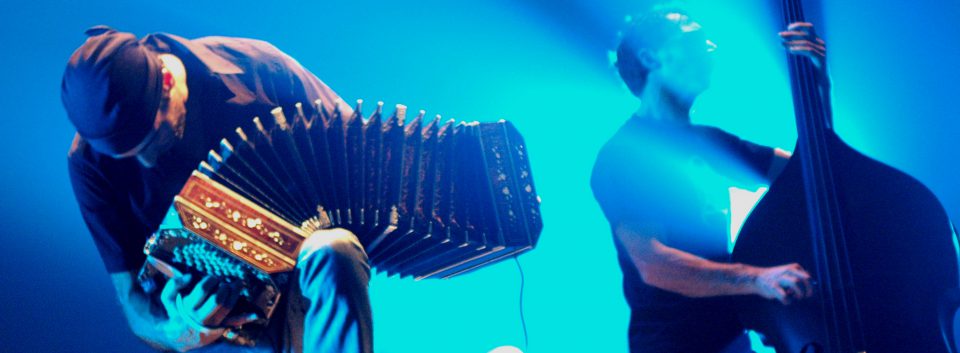
At the Dranoff 2 and Nu Deco Ensemble concert at New World Center in Miami Beach on Sunday, solemnity lasted a few bars — just enough for the orchestra to unpack the famous theme of Johann Sebastian Bach’s “Tocatta and Fugue in D Minor,” and turn the piece into “Tocatta y Fuga en Re Minor,” as the program titled it. The arrangement by composer Sam Hyken, co-founder and co-artistic director of Nu Deco, quickly put Bach in the Caribbean, swaying in clave and leaving room for congas and a timbales solo — and off we were.

The collaboration between the 29-year-old Dranoff International 2 Piano Foundation and the upstart Nu Deco Ensemble, a Knight Arts Challenge winner, could not have begun much better. The evening featured terrific performances by the piano duo Yoo + Kim (Jackie Jaekyung Yoo and Yoon-Jee Kim), winners of the 2013 Dranoff International 2 Piano competition in Miami, including the first movement of Rachmaninoff’s “Symphonic Dances” and the premiere of “Concerto for Two Pianos and Orchestra” by Swedish composer Fredrik Sixten, who was in attendance. The program also featured the ensemble at its best, playing music by Steve Reich, Jessie Montgomery, Radiohead, Bach and Frank Zappa. Better yet, it all played before an enthusiastic and diverse sold-out audience.
Continue reading

Art as social practice — and vice versa


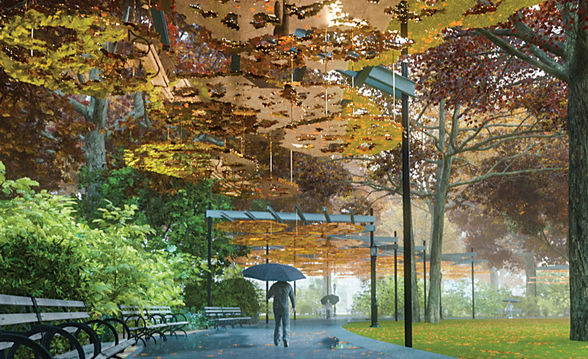
An image of Teresita Fernández´s “Fata Morgana” at Madison Square Park, New York City.

This piece was posted on the Knight Foundation  blog in October 2016

It was perhaps fitting that an event titled “Artists As Citizens” took place on the same evening of the final presidential debate of this election season. But the conversation, held Wednesday at the headquarters of the National YoungArts Foundation in Miami as part of its Salon Series, was not about partisan politics but art, activism and social practice, beauty and community engagement.

In fact, the talk, featuring artists Teresita Fernández, Mel Chin and Chat Travieso, was “the beginning of a dialogue here in Miami about social practice and how artists want to engage in this kind of work that we need to model better, “ said host Carolina García Jayaram, president and CEO of the National YoungArts Foundation, in her introduction. By the end of evening, the extraordinary work and the broad range of approaches discussed spoke of the importance and enormous potential of social practice.

Continue reading

Last stop: Paco de Lucía

Paco

The subway line that passes by where I’m staying in Madrid begins (or ends, your choice) at Paco de Lucía station. It is a new extension and the new station was going to be called something else, but then the great guitarist and composer died (on February 25, 2014) and when it opened last year it was named after him.

As it turns out, in a used book stand by El Retiro, this weekend, I found “Paco de Lucía El Hijo de la Portuguesa” (Paco de Lucía The son of the Portuguese woman) by Juan José Téllez (2015, Planeta) and it´s a close, intimate bio by a friend. (I don’t know if it´s out in English yet but it’s worth searching for it.)

Some of Paco´s quotes should be must reading for young musicians: “I’m always very open, in general, to criticism. In fact, I like the negative criticism more than I like the favorable one, because I’m used to compliments and adulation. When I see bad review I’m interested in what they are saying and finding what I can get from it.” Or, when discussing tradition, “If you anchor yourself in the past, each day you’re dying a bit more.”

Music is such a mysterious art. We hear ten guys who play guitar fast, cleanly, with great emotion, yet we can hear that THAT one is different. Then we learn that Francisco Sánchez Gomes read three books a week (from Dickens to Murakami to Perez-Galdós,” says his son Curro), loved movies — Hitchcock, John Ford but especially Billy Wilder are mentioned — and had marathon weekends of Spanish film … and there is just so much more to the man, and it’s all in the music. A friend calls him “un revolucionario conservador,” a conservative revolutionary or, perhaps, a revolutionary conservative.

A good spot for the beginning (or end, your choice) of a line.

30 May, 2016 – Madrid