Recordings: Drummin’

The Offense of the Drum
Arturo O’Farrill & The Afro Latin jazz Orchestra
(Motema)

Maestro Mario Bauzá — trumpeter, saxophonist and music director of Machito and His Afro-Cubans, direct link between Dizzy Gillespie and Chano Pozo and a key figure in blending jazz and Afro-Cuban rhythms — scoffed at the label Latin Jazz.
“What they call Latin jazz is not Latin jazz. That’s Afro-Cuban jazz,” he would say in his inimitable growl. It wasn’t just that “Latin jazz” blurred the Afro-Cuban contribution. It was also that, for him, Latin jazz suggested a different, more varied mix — incorporating Argentine tangos, Colombian cumbias, Venezuelan joropos or Puerto Rican bomba y plena. He would then name artists such as Paquito D’Rivera, Gato Barbieri or Jorge Dalto as worthy practitioners.
It was the 1980s and it was a short roll call.
Today, he would’ve had a much longer and broader list.
But Bauzá would have been specially proud of the work of pianist and bandleader Arturo O’Farrill, the son of his friend and collaborator, the great Cuban arranger and bandleader Chico O´Farrill.
For 12 years, sometimes seemingly hidden in plain view, Arturo O´Farrill has carried on an extraordinary effort, not only organizing and keeping alive an 18-piece big band but doing so while also expanding the vocabulary of Afro-Cuban jazz into a truly Pan-Latin Latin jazz.
By now, the book of the Afro-Latin Jazz Orchestra (ALJO) includes not only some of the great standards of Afro-Cuban jazz but also pieces blending in tangos, choros and Peruvian festejos.
In The Offense of The Drum, O´Farrill both takes it further out as he brings it all home.
With the drums as the foundational center of the music, the ALJO connects diverse traditions creatively but also rather organically.
So a tribute to the shared spirits and grooves in Havana and New Orleans, a musical dialogue in “On The Corner of Malecón and Bourbon,” flows into a sly Colombian porro groove and allusions to Colombian papayera band (a type of brass street band) on “Mercado en Domingo.”
But exploring the groove doesn´t preclude a reflective “Gnossienne 3 (Tientos),” which explodes Erik Satie’s music Arabic elements with a flamenco perspective.
And O’Farrill is neither afraid of collaborations — such as those with pianist Vijay Iyer (the odd mettered “The Mad Hatter”) and DJ Logic (“They Came” which also explores spoken poetry) — nor having a good time, as with the eminently danceable salsa track, “Alma Vacía,” or the classic “Iko Iko,” featuring alto saxophonist Donald Harrison, a Big Chief Mardi Gras Indian, reinvented here as a joyous, bouncing Cuban/New Orleans party groove.
Throughout, the arranging is imaginative, exploring the character of the music and the instrumental possibilities of the band, while the soloing (especially by O’Farrill and Iyer on piano, Rafi Malkiel, euphonium and Harrison on sax) is consistently smart and purposeful.
Creative, swinging and open to the world, The Offense of The Drum is Latin jazz at its best.

Why?
Ginger Baker
(Motema)

While lasting only two years, 1966 – 1968, the British trio Cream had an oversized impact in modern popular music. At different times, Cream has been claimed as ancestor and inspiration by rock musicians of nearly all stripes, from fusion to heavy metal.
But jazz has more than a fair claim to their legacy too. In fact, one doesn’t need to go back to their epic version of Skip James’ “I’m So Glad,” in the group’s final Goodbye, to connect the dots between the jazz tradition and their instrumental virtuosity, approach to improvisation and open-ended treatment of the blues. Set aside the pop-rock imagery for a second and think of, say, a saxophone playing the guitar lines and you are closer to an avant-jazz trio than a rock band.
That shouldn’t be a surprise. The two guys working the engine room of Cream, bassist Jack Bruce and drummer Ginger Baker, were educated in, and fans of, jazz. Guitarist Eric Clapton was a different story — and his post-Cream, MOR career is evidence enough. In his autobiography, Bruce seems to suggest that two-thirds of Cream thought of it as a jazz trio adding, jokingly one would hope, that they just wouldn’t tell Clapton about it.
With his new album Why?, his first in 16 years, Baker, 75, seems to be closing the circle, returning once again, in one gesture, to his old loves — jazz (including two appealing trio records in the 90s with Bill Frisell and Charlie Haden), African music and, essentially, the trio format (replacing the guitar with a horn and in fact playing without a chordal instrument this time).
Baker’s band these days, Jazz Confusion, features Pee Wee Ellis on sax, Alec Dankworth, bass and Abass Dodoo, percussion, and offers the drummer a smart, strong, no-frills vehicle.
The repertoire in Why? also suggests a bringing-it-all-home feel.
It’s comprised mainly of Baker’s originals, including “Ain Temouchant,” recorded with Frisell and Haden on Going Back Home (1994); “Cyril Davis,” (sic) a tribute to the British harmonica blues player Cyril Davies, and trumpeter Ron Miles’ “Ginger Spice,” both first recorded on Baker’s Coward of the County (1998); and the title track, a meditation on his life and work including a tip of the hat to the late bandleader Graham Bond.
The set also includes “Aiko Biaye,” an update of a Nigerian song Baker recorded in 1970 with Air Force, his short-lived sui generis big band; Ellis’ “Twelve and More Blues,” and a couple of jazz standards, Wayne Shorter’s “Footprints” and the irresistible “St. Thomas,” by Sonny Rollins.
Throughout, Ellis is an economic and tightly focused improviser, even as he takes flight on tracks such as “St Thomas” and his own “Twelve and More …,” remade here with a post-bop swing. Dankworth is solid and fluid throughout, anchoring the group and providing measured, eloquent soloing.
Baker drives the music forward with his distinct drive and African-tinged tom-tom and hi-hat sound. There it might not be in his playing the relentless, maniacal intensity of his heyday (how could there be?) but Baker’s craftiness and musicality more than makes up for what he might lack at this point in energy.
In Why? Baker embraces his past — but don’t expect a warm-and fuzzy nostalgia trip. To quote the title of the terrific Jay Bulger’s 2012 documentary about him, Beware of Mr. Baker. And that’s a good thing.

Beware of Mr. Baker
http://www.youtube.com/watch?v=W5seWMYG9kk

August 2014, The International Review of Music / Jazz With An Accent

Recordings: Bandoneón and tango, with an accent

El Valle de la Infancia
The Dino Saluzzi Group
(ECM)

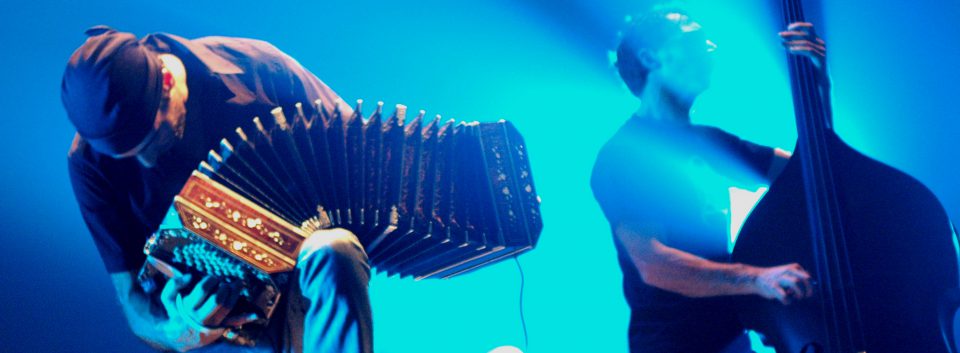
The bandoneón, a button squeezebox, might have been born in Germany as a poor man’s harmonium for religious services, but found its calling, and reached global recognition, in tango, in Buenos Aires, Argentina, half a world away. But bandoneonist Dino Saluzzi was born in a dusty small town in Salta, in Argentina’s Northwest, not the big city; and he first heard the bandoneón in folk music not tango. Naturally, and especially early in his career, in the late 60s’early 70s, Saluzzi brought the instrument to his folk music projects. And even as he later earned his tango credentials playing in classic tango orchestras in Buenos Aires, his approach to the bandoneón has always had a distinct, personal accent.

In his own music, Saluzzi has long since developed a style in which he has blurred the lines between European classical music and jazz — with a tango and folk tinge.

On El Valle de la Infancia (The Valley of My Childhood), Saluzzi, 79, comes full circle, taking stock on his musical history through the filter of the styles that have since marked him.

As it probably couldn’t have been otherwise, El Valle de la Infancia is a family affair. His sextet includes his brother Félix on sax, his son José María on guitar and his nephew Matías on bass. (Nicolás “Colacho” Brizuela, guitar; and Quintino Cinalli, drums and percussion complete the group.)

Both as a composer and improviser, Saluzzi has a particular way of setting and telling his stories. He establishes the mood with a few bold strokes, and then, more often than not, lets the themes emerge, digressing unhurriedly, adding a point here, a change-of-pace detail there as the tale unfolds.

“La Polvareda” wanders off from a near religious mood into a festive folk tune and out again. “A Mi Padre y a Mi Hijo” turns unexpectedly into a modern tango that suggests a salute to Astor Piazzolla before dissolving and reappearing as an old-style milonga. The music is not necessarily thru-composed but, for the most part eschews the standard forms. In fact, except for four of the 16 tracks, Saluzzi sets the program as a collection of suites. The connecting thread might not always sound obvious at first listening. In “Pueblo” the three pieces are each from a different composer — and he is none of them. And Saluzzi not only invokes certain traditional folk rhythms (such as in “Charqui” which draws from the folk music of Argentina’s Northwest) but also includes songs by master folk composers such as Atahualpa Yupanqui and Ariel Ramirez.

El Valle de la Infancia suggests the work of a master in winter, still looking ahead as he glances back.

In The Key of Tango
Carlos Franzetti
(Sunnyside)

Argentine-born pianist, composer and arranger Carlos Franzetti’s career defies easy labels. He has recorded jazz, tango and pop, has written chamber and symphonic music, operas and film scores, collaborated with jazz musicians, pop artists and rockers. Two recent projects, In The Key of Tango and Panamanian singer and songwriter Rubén Blades´ Tangos, brings him back to his musical roots and the results are impressive.

On In The Key of Tango, a solo piano outing, Franzetti revisits a repertory of classics, including Carlos Gardel’s “Soledad,” Virgilio Expósito’s “Naranjo en Flor” and Astor Piazzolla’s “Adiós Nonino,” as well as his own “Tango Fatal,” the title piece form his 2000 ballet.

It might sound like a simple, even natural task. But being bilingual means, inevitably, to lose some of the turns, nuances and accents of the original language. That, remarkably, is not the case here.

Old school jazz players talk about the need to know the lyrics to properly play and improvise over a song. On In The Key of Tango one can almost hear Franzetti singing along, coming to the precise pause, adding a baroque touch of flair, playing on the drama of certain phrase, speeding up and slowing down like a good club dancer. And he brings to his interpretations not only his substantial technique as a player but an arranger´s ear — now staying simple and direct, now being melodramatic, now suggesting orchestral accents (orquesta típica accents) as needed.

In The Key of Tango is not only a terrific addition to Franzetti´s discography but it makes for a smart entry point to the classic tango repertoire.

Tangos
Rubén Blades
(Sunnyside)

Recorded in Buenos Aires and New Jersey and featuring the great bandoneón master Leopoldo Federico and his orchestra, a United States-based sextet and The City of Prague Symphony Orchestra, Rubén Blades´ Tangos is a very different tango project.

Here the repertoire is comprised by Blades´s salsa classics such as “Paula C,” “Pablo Pueblo,” and “Pedro Najava,” and the challenge, for both, singer and arranger, was to re-create them as tangos.

Set with a jeweler’s touch by Franzetti’s arranging, Blades’ singing, for the most part, works. No, he doesn’t have a tango voice nor the phrasing. But, bringing to bear his experience as an actor, Blades sings with flair, trusts the words (and why not? He is one of the prime storytellers in Afro-Caribbean music) and doles out the drama judiciously.

For the most part, Franzetti sets the songs in a neo traditional tango orchestra style and it works — and his re-imagining “Pedro Navaja” and “Adán García” as sui-generi milongas works particularly well.
Probably not for tango purists, but a contribution to the genre nonetheless

July 2014, International Review of Music / Jazz With An Accent

The joys of jazz , revisited

If their recent show in Coral Gables, Florida, was any indication, and you love jazz, you need to hear the Preservation Hall Jazz Band live.
You might dismiss it, as I once did, foolishly, as just a repertory band, a sort of charming, rolling live museum act evoking what might-have-been. And there might be some of that. But with the Preservation Hall Jazz Band you also get the joy of jazz, smart, angst-free jazz, played with great professionalism but also with pleasure and a sense of humor (watching sousaphone player Ronell Johnson march in place, bob, weave and turn all the way through the performance was part of my enjoyment that night).

The music was soulful and swung forcefully yet with a casual grace of a conversation among old friends, counterlines seem to grow along, curling like vines around the main melody. It was both sturdy and lithe, complex yet appealing. The ensemble played what it must, but the audience clearly felt invited in. I suspect jazz gained a few more believers that night. Having fun is an undervalued concept in jazz — and the music has paid dearly for it. But the Preservation Hall Jazz Band taught a master class in jazz disguised as a good-time show. That’s an art in itself — and jazz has had some great practitioners. (Dizzy is a prime example of the genius disguised as entertainer).

Obviously, not every style in jazz lends itself easily to this approach. But by definition, jazz will always live in that netherworld between art music and entertainment. It’s both a weakness and a source of strength. And to have a place in the cultural marketplace, jazz needs to connect with audiences, be it in the composition, the playing or the presentation.

It played out vividly before me at that show by The Preservation Hall Jazz Band, an ensemble created 50 years ago precisely to evoke the very roots of jazz — in substance and form.

No, the challenge is not new, but the urgency is — or we can look at classical music and see the future of jazz.

June 2012, The International Review of Music / Jazz With an Accent

(photo credit Shannon Brinkman)