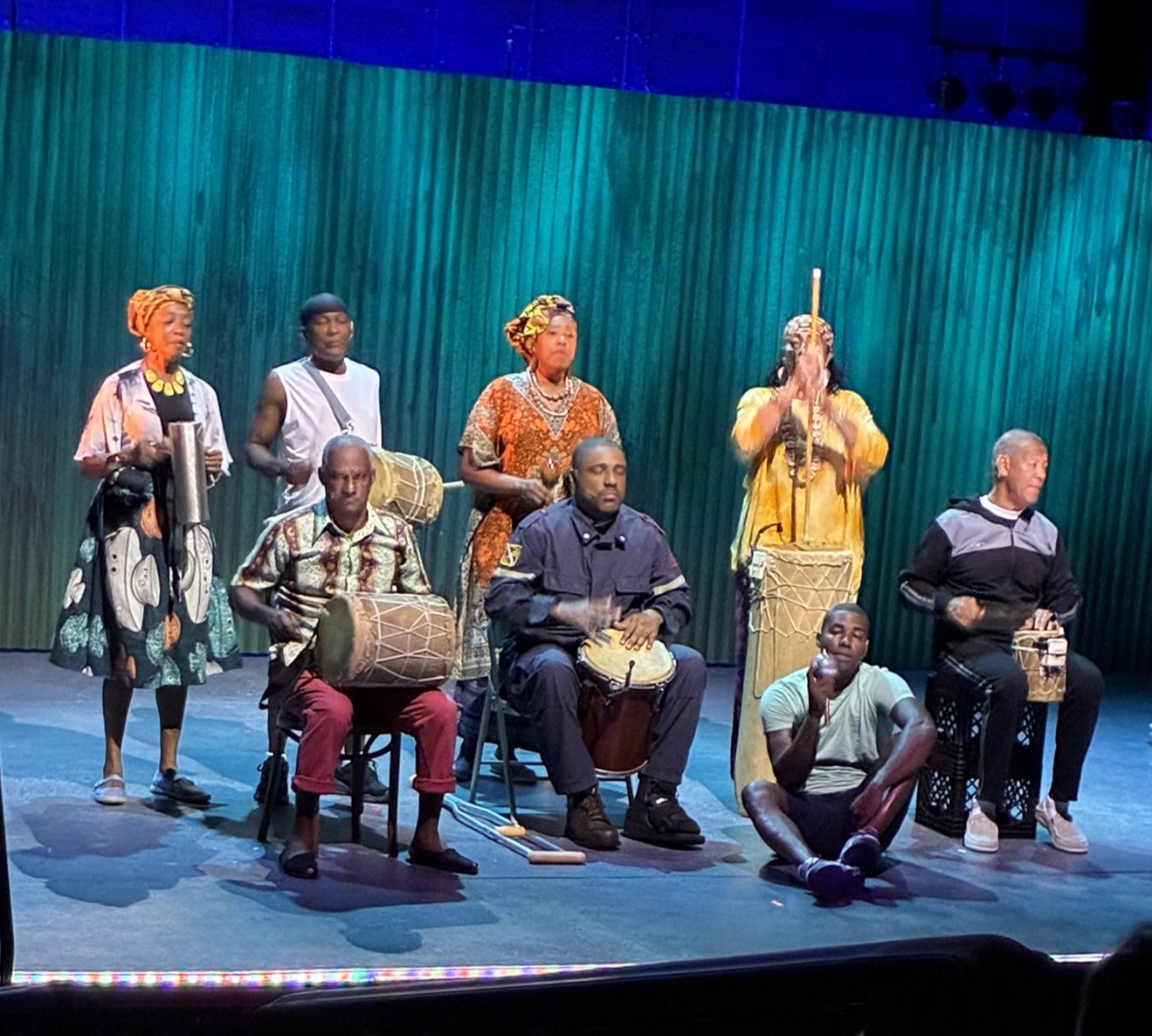
The eight-member Parranda El Clavo group on stage is a small representation of the actual parranda. “The parranda is the whole town,” says singer Betsayda Machado. “But I couldn’t bring the whole town onto the stage.” From left to right, top row, Nereida Machado, Oscar Ruiz, Betsayda Machado, and Blanca Castillo; seated, Adrian “Ote” Gómez, Youse Cardozo, Nelson Gómez, and Asterio Betancourt, performing on opening night. (Photo by Fernando Gonzalez)
“Paint your village and you will paint the whole world” is advice attributed to Nobel Prize winner Leo Tolstoy. Few theatrical experiences in recent memory make the point as vividly or successfully as the immersive music-driven production “¡Viva La Parranda!”
The musical, commissioned by Venezuelan-born theater director, writer, and producer Michel Hausmann, co-founder and artistic director of Miami New Drama, and produced by Miami New Drama, returns to the Colony Theatre in Miami Beach, featuring the original ensemble after a successful run in South Florida in 2019 opening Thursday, July 10 through Sunday, July 27. Barlovento has deep, centuries-old African roots, and the ensemble plays its music on ancestral instruments such as the mina (a large drum with roots in what is now Benin), the culo’e puya (small drums of Kongo origin), and the quitiplás (bamboo drums). It also includes moving personal stories told by the performers, all of whom are neighbors of El Clavo. They aren’t professional actors, but their grace and emotion come from authenticity.
Born in Caracas but raised in El Clavo, where her mother still lives, Machado was already a leading voice in Afro-Venezuelan music when an inquiry by producer Juan Souki led to the idea of capturing the experience of la parranda, a genre of Afro-Venezuelan music, but also the name of the ensemble that plays it and the party around the music.
Souki was an admirer of Machado long before they met.
“I just knew her voice from a recording. It was a large vocal ensemble, so I didn’t even know her name, but I recognized her voice. Betsayda has such a universal voice that it feels like she can sing to you about the pulse of the earth,” he says.
Souki had collaborated with Machado on a bolero project and wanted to work with her further, so he asked her to show him something of interest from her hometown.
“And I told him, ‘Well, from my house, for as long as I can remember, there is a parranda every January first.’ The parranda in the pueblo de El Clavo is older than me, and I’ll be 52 in August,” says Machado, breaking into a laugh during a telephone interview and speaking in Spanish.
“So I took him to the town one weekend,” she says. “I brought all the parranderos up to date; they prepared as if Juan were a visiting mayor, and he was welcomed with a sancocho.”
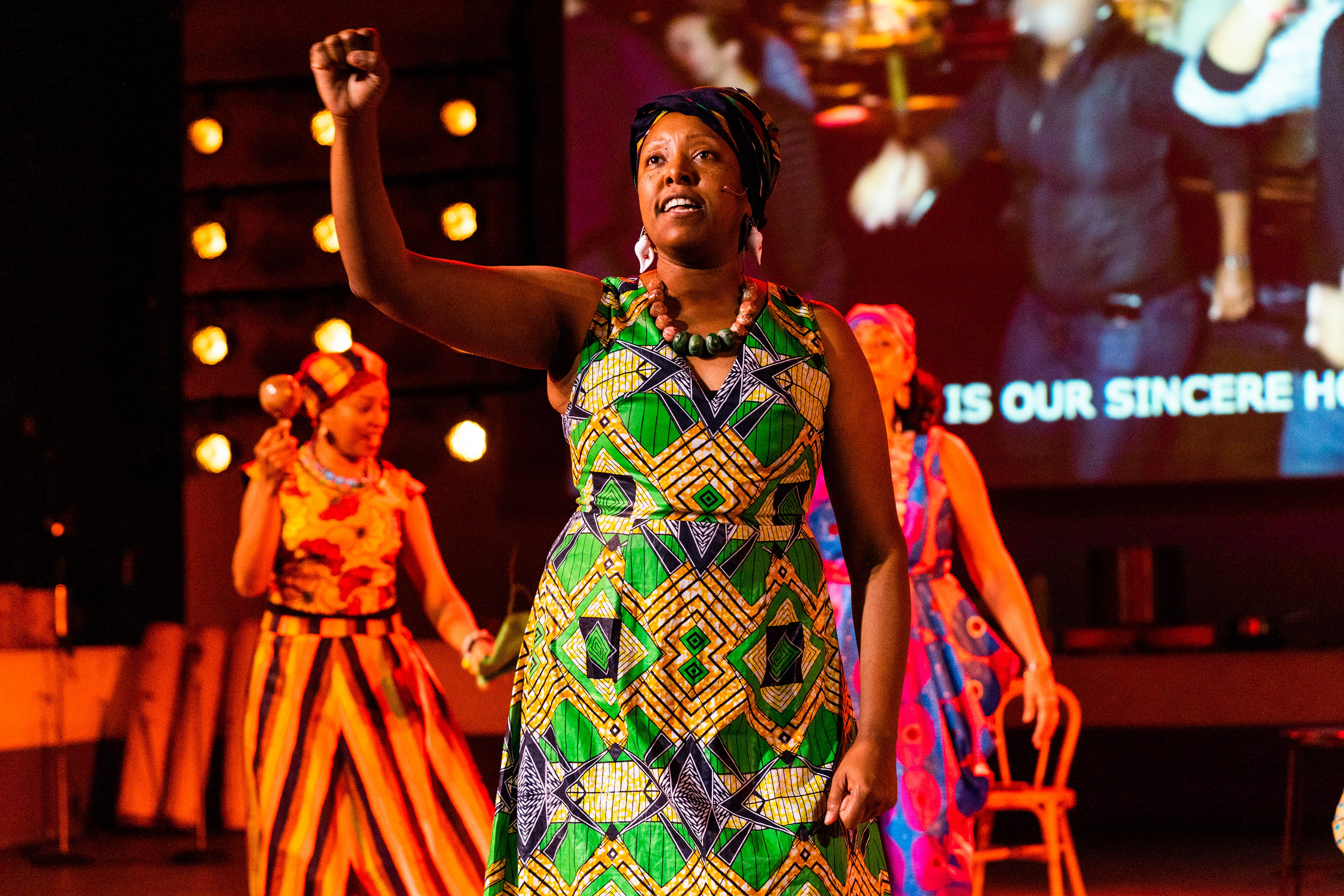
Singer Betsayda Machado is a leading, commanding presence in “¡Viva La Parranda!” The musical transports the audience to El Clavo, a small town in Barlovento, Venezuela, and is staged as a backyard get-together. (Photo by Xavier Lujan, courtesy of Miami New Drama)
The encounter and hearing Machado perform in place with the group led to a recording featuring her with La Parranda El Clavo: Loé Loá (Rural Recordings Under the Mango Tree). The title was no marketing cutesy. “No, sir. It was recorded under a mango tree,” says Machado. “And we invited the whole town so that they could experience what it was like to record an album. Because this was the first time that the group was called to do a recording.”
It was also Souki’s first recording. “And my last,” he quickly adds. “It’s not what I do. But that album ended up on the New York Times’ list of the best albums of 2017.”
The reception of their recording opened the world to Machado and La Parranda El Clavo, leading to international touring and appearances at events such as WOMEX and Global Fest, and venues such as the Kennedy Center in Washington, D.C.
“The farthest the group had gone was the town of El Guapo. Our first trip [after the album] was to Canada,” says Machado, adding that “of course,” the group on stage is only a small representation of the actual parranda. “The parranda is the whole town,” she says. “But I couldn’t bring the whole town onto the stage.”

From left to right, Jose Gregorio Gómez, Asterio Betancourt, one of the founders of La Parranda El Clavo, and Youse Cardozo. Barlovento, Venezuela, has deep African roots, and the ensemble’s music is a showcase of Afro-Venezuelan rhythms on ancestral drums. (Photo by Xavier Lujan, courtesy of Miami New Drama)
Hausmann has known Souki since they were both teenagers in Caracas, Venezuela, and, as he puts it, “precocious theater directors.” However, at some point, Souki transitioned to music production and world music, recalled Hausmann. When Hausmann learned about the Parranda El Clavo project, he was moved. “Juan was posting videos about it, and I called him and told him, ‘We got to do a play with them . . . So we spoke about the idea of a documentary play.”
The result is a one-of-a-kind, profoundly moving theatrical documentary.
The backyard staging sets both the personal storytelling and the music to unfold naturally. “I remember that I said that we were going to prepare a sancocho,” says Machado. “And that’s how we have it in the play. Our first experiences as parranderos were born with a sancocho.” Naturally, at the end of the performance, the audience is invited onstage to share the experience and taste the food. That is no showbiz; that is the way of El Clavo.
In addition to Machado, members of the ensemble include Blanca Castillo, a retired nurse; Youse Cardozo, a firefighter; Asterio Betancourt, a founding member of the parranda, a former basketball player and drummer; and Nereida Machado, Betsayda’s sister, who is a singer, dancer, and insurance analyst.
The stories they tell speak of family and community but also violence, death, single parenthood, drug use, and the back-breaking work in cocoa fields.

¡Viva La Parranda! offers music, food, and moving personal stories told with disarming grace and emotion. (Photo by Fernando Gonzalez)
“They tell their stories in anecdotes,” says Souki. “At the end of the day, it’s soup, a beer, rice, and telling stories. The text is the literal anecdotes from them and their experiences as they were told to me in a very informal context, not from interviews, but long days of conversation.”
In the lead-up to the first run at the Colony Theatre in 2019, Hausmann had said, “¡Viva La Parranda! is a story this country badly needs. It’s a timely antidote to poisonous rhetoric that dehumanizes foreigners, especially Latin Americans, from countries in crisis. For the political and economic disaster in Venezuela to have a human face, we need to hear the individual stories of people’s lives.”
If anything, the political climate for immigrants and refugees has become more dire since.
“When I programmed the show again, they had not rolled back the TPS (Temporary Protected Status) yet, but it was very clear that the anti-immigrant rhetoric was very high again. It is in that context that we decided to bring back “¡Viva La Parranda!” says Hausmann. “It breaks my heart to see how a lot of the progress that had been made is being rolled back. There’s a dictatorship back home. There are 8 million Venezuelans in the diaspora, most of them refugees.” To put it in perspective, according to UN data, Venezuela’s population is approximately 28.5 million.
“Part of the reason we are bringing it back is because we might have done that show a little too early in our company’s career. We didn’t have sort of the big Venezuelan audience that we were able to cultivate afterward, and this is our way of reminding this community that there is something intrinsic in the Venezuelan spirit that allows us to stand up and […] continue at it in the face of adversity.”
But there is also a more universal consideration, suggests Hausmann.
El Clavo is located “an hour and 20 minutes away from where I was born and lived most of my life (Caracas, Venezuela’s capital) — yet we really are worlds apart,” he says. ”And their experiences are even more removed for people who are not from Venezuela — and yet the emotions are so powerful because they are raw and they are real. It is impossible not to connect with what they feel because we all recognize those emotions. And I think that that is the power of theater: to remind us that we are all made of the same emotional DNA and to some degree, every story is a universal story.”
An edited version of this story was posted in Artburst Miami on July, 2025
 Jazz With an Accent