
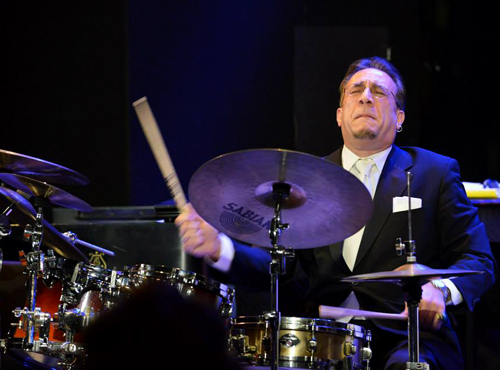
Bobby Sanabria leading the Multiverse Big Band at Dizzy´s Club Coca-Cola.
Photo by Frank Stewart
Bobby Sanabria was born of Puerto Rican parents in the Bronx, New York, in 1957, the year West Side Story debuted on Broadway. He saw the film version years later, as a young man, with his parents and his sister, and in Leonard Bernstein’s musical setting of Shakespeare’s Romeo and Juliet in mid-50s New York City, he heard something familiar yet also oddly new.
“At that time there wasn’t anything that acknowledged the contributions we had made, let alone the existence of NYC’s Puerto Rican community, other than articles about gangs and crime in relation to us,” wrote Sanabria, a drummer, composer, arranger, and educator in an essay about West Side Story published by the National Institute of Latino Policy. “Despite the racism my parents had experienced, and subsequently my sister and I were also subjected to, we somehow knew that our existence, our historical presence in the city had literally transformed it culturally, stylistically, and of course musically. The authors knew this as well.”
Of course, West Side Story is also a story about gangs in New York (“How could it not, it was an undeniable reality,” acknowledges Sanabria in the essay) but Sanabria saw more than that.
“It’s a complex story of romance set in the energy of the inner city amidst racism, bigotry, territorial imperative, and what causes it — fear and ignorance that’s offset by cultural pride, humor, and the spirit of fighting for what one believes in,” he writes.
Leading his 21-piece Multiverse Big Band and featuring the writing of nine arrangers, in West Side Story Reimagined (Jazzheads), Sanabria expands and updates nearly all of Bernstein’s charts. Mirroring the original, it is an ambitious musical piece that also bears witness of the times.
“This is a tribute to Bernstein, his 100th birthday and the 60th anniversary of West Side Story, but it’s also very much a socio-political statement,” said Sanabria in a recent interview from his home in New York. “It’s a different kind of statement because this is all instrumental, but people will get the message. The music is the message.”

 Jazz With an Accent