Chick Corea, in the words and music of Chucho Valdés

Chick Corea and Chucho Valdés at a rehearsal space, in the days before their joint appearance at Jazz @ Lincoln Center, November 2019. Photo courtesy of Lorena Salcedo Valdés ©

The announcement of the death of keyboardist composer and bandleader Chick Corea on February 9 at 79 brought about shock, sadness, and a flood of deserved praise. But the announcement also delivered one last composition by Corea, as vital and generous as so much of his music.

“I want to thank all of those along my journey who have helped keep the music fires burning bright,” wrote Corea. “It is my hope that those who have an inkling to play, write, perform or otherwise, do so. If not for yourself then for the rest of us. It’s not only that the world needs more artists, it’s also just a lot of fun.”

“And to my amazing musician friends who have been like family to me as long as I’ve known you: It has been a blessing and an honor learning from and playing with all of you. My mission has always been to bring the joy of creating anywhere I could, and to have done so with all the artists that I admire so dearly — this has been the richness of my life.”

One of those musicians was Cuban pianist, composer, and bandleader Chucho Valdés, 79, a longtime fan of Corea. It was not surprising then that, when offered a choice of a guest for his concerts at Jazz at Lincoln Center in November 2019, Valdés chose Corea.

Days after the announcement, Valdés still sounded shaken by the news.

“As a musician, I believe every pianist in the world has learned something from him,” said Valdés. “As a human being, I was amazed by his greatness, his simplicity, and his humanity. Vaya, I have no words to describe him. In my life, I’ve met few people like him.”

He recalled first hearing of Corea back in Havana in the late 60s when the closely-knit community of jazz musicians and fans got most of their news and music listening to Willis Conover’s “Jazz Hour” on The Voice of America.  

“That’s how I had discovered Herbie [Hancock],” he noted. “But it was Carlos Emilio [Morales, his long time friend and guitarist of Irakere) who came and told me ‘I heard on Willis Conover a new record by Stan Getz. Man, he has a pianist that’s out of this world. His name is Chick Corea.’ It was 1967, and that’s when I started listening to Corea, and of course, then came Return to Forever and from then on, I followed his career to this day.”

They eventually met at a jazz festival in Sardinia in the 1980s, “and then we crossed paths at many festivals,” recalled Valdés.

“Sometimes, with people you admire, you can’t believe that they are gone. Chick dead? It can’t be,” he added. “Look, for me, Chick has left such a big void, not only in jazz but in music, that it will be very difficult to fill.”
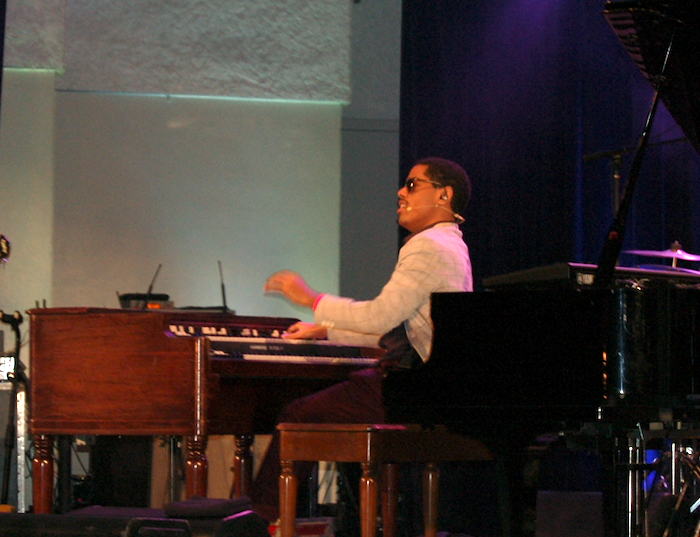
Matthew Whitaker at the South Beach Jazz Festival

When pianist and organist Matthew Whitaker closed his concert at the South Beach Jazz Festival in Miami Beach on January 8 with Kool & The Gang’s “Celebration,” for a moment, months of fear and isolation seemed to dissipate. A few in the properly distanced, limited-numbered audience at the open-air North Beach Bandshell got up and danced. It felt equal parts a gesture of release and defiance. For many of us, the simple act of attending a live show and sharing the music with a group of fellow human beings, in person, even if at a distance and with masks, was both extraordinary and wonderfully mundane.

There was nothing ordinary about Whitaker, however. A blind, prodigiously talented 19 year old (he won’t be 20 until April) with a light touch and quick hands, he was fearless enough to jump in the deep end of bop, classic 70s electric fusion, R&B, Latin jazz — and bring to the party a couple of original tunes.

Backed by his regular quartet — Marcos Robinson, guitar; Karim Hutton, bass; and Isaiah Johnson, drums — Whitaker zigged and zagged unhurriedly between Eddie Harris’ “Freedom Jazz Dance,” Charlie Parker’s “Yardbird Suite” (which he approached in an organ trio format), and Herbie Hancock’s “Actual Proof ” — before turning left and revisiting Jorge Ben’s “Mas Que Nada,”  a hit for Sergio Mendes in the 60s, his own piece “Emotions,” and for good measure, Earth Wind & Fire’s catchy “September.”

But Whitaker does not seem to program this material for the sake of nostalgia or as a revivalist. As promising as he appeared as a player, he sounded just as intriguing as an arranger. With his song choices, he sometimes suggested an archeologist going through old artifacts, trying to understand what life was like back then — only to put it back together his own way. Every piece seemed to have several time signatures, a couple of tempo changes, and harmonic passageways to unexpected resolutions. He good-naturedly poked and pulled at the material, as if to find what else might be there, how far it would stretch, whether it was Chick Corea’s speed test “Got a Match?” or Deniece Williams’s anthemic “Black Butterfly.”

An astounding facility at the keyboards, a curious mind, and an engaging presence as a performer make a great combination. Whitaker has justly gained a lot of recognition and applause at a young age; more, no doubt, is to come.

A note about the festival: Whitaker was an inspired choice to launch the fifth edition of this three-day South Beach Jazz Festival, a fundraiser for the non-profit organization, Power Access which has as a goal “to bring awareness to the community about people living with disabilities and to provide opportunities for those people.” The Festival, by design, “takes pride in featuring world-renowned musicians who also have disabilities.” Another reason to celebrate.

Photo courtesy Harvey Burnstein of MiamiArtzine

This story appeared in JAZZIZ Magazine

Luis Olazábal: Making Music for Your Eyes


Luis Olazábal photo courtesy of Sandra Abousleiman @mypinkpanthetravels ©

Not every musician plays an instrument or writes music.
Luis Olazábal used his camera to make music with images. A dear colleague and arguably the premier performing arts photographer in South Florida, Luis died in his native Lima, Peru, on June 30 of pancreatic and liver cancer. He was 52.

Luis worked for notable clients, including the JVC Jazz Festival, Sony-BMG Music, Miami-Nice Jazz Festival, Miami International Jazz Fest, Miami Light Project, Tigertail Productions, and the adventurous Subtropics Festival. But since 2004, he was the official photographer of the Rhythm Foundation, a Miami Beach-based non-profit that presents music from around the world.

We shared many moments in the back rows of the North Beach Bandshell talking about music and musicians while taking in all kinds of shows – from Haitian roots music and jazz to Cuban funk, classical, gospel, you name it. He was an informed and astute listener with a great eye.

It made his photographs different.
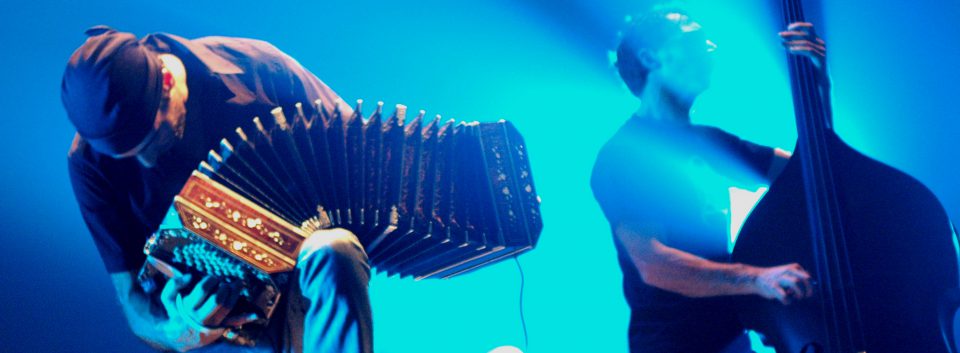
His work illustrated many stories on this blog. The picture on the header is his.

When I told him about the idea behind the blog I was starting and asked him for an image for it, he said he would think about it, and later that day he sent me some photos. The one I chose was just the second or third I saw. He had some technical objections I didn’t understand and, frankly, he wasn’t crazy about it. But I loved it, so we agreed it would be a placeholder, just to get rolling. Of course, I had no intention of changing it. His photo was, and remains, a better statement about what this blog is about than any description I could write.

That’s the power of his work.

As it turns out, Luis didn’t plan on being a photographer, but, as he was fond of recalling, he saw an exhibit of black & white images of jazz and blues performers by Herman Leonard while on a walk on Lincoln Road. Those photos, he said, “made me realize exactly what I was meant to do. At that moment, I knew that music photography was my calling.” We were lucky he did.

In a town too often dazzled by loud, shiny, and inch-deep, Luis was unassuming, truly talented, and serious about his craft. You can enjoy more of his work here.

Some day we will have concerts at the Bandshell again, and then, I hope to be somewhere in the back rows, listening and taking notes — and I know it will hit me.

I will miss him.