Cuban Music With a Classical-Pops Twist

Joachim2

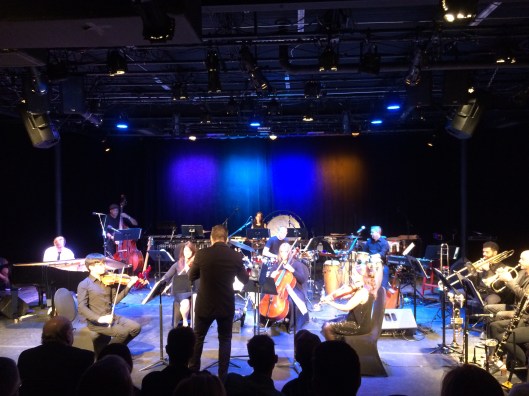
Pianist Joachim Horsley performing with the NuDeco Ensemble Nucleus conducted by Nu Deco Ensemble co-founder and co-artistic director Jacomo Bairos at The Light Box, Miami.

The second of three nights of Global Cuba Fest 2019, presented by Miami Light Project and Fundarte at The Light Box in Miami, delivered an entertaining evening of classical-pops takes on Cuban music.

Impeccably anchored by the slimmed-down, Nucleus version of Miami’s chamber group NuDeco Ensemble, the concert featured Cuban multi-instrumentalist, singer and songwriter Yusa, and German pianist, composer and arranger Joachim Horsley in a program that included music by Ernesto Lecuona, original songs; a rumba version of  “Close to You;” Danzas Cubanas 2.0, a sort of Cuban music sampler by Nu Deco Ensemble co-founder and co-artistic director Sam Hyken; and several of Horsley’s What-if Mozart/Beethoven/Saint-Saens had-been-born-in-Havana? confections.

Will classical music lovers in attendance last night be intrigued now into finding out more about Los Muñequitos de Matanzas, Arsenio Rodríguez or Los Van Van? Will hardcore Cuban music fans want now to hear a full-bodied reading of Mozart’s “Lacrimosa”? Who knows? It’s hard to tell what’s the ultimate impact of these hybrids, but in the meantime, a good number of music enthusiasts in Miami kicked back last night, put preconceptions in their bags and back pockets, enjoyed themselves, and rewarded players and presenters with a standing ovation.

Purists beware, you might have a good time.


Global Cuba Fest 2019 continues tonight. For more information and tickets check here.

Diego Guerrero: Jazz, rumba and the sound of Nuevo Flamenco

DIEGO GUERRERO - COLOMBINAS 2017_4839 copia

Diego Guerrero Photo by Alejandro Lopez, courtesy of Fundarte

Like jazz, perhaps a distant cousin, flamenco began as regional music of a displaced, desperately poor and disenfranchised people. And like jazz, flamenco began as fusion, a mix of new sounds and instruments and whatever memories had been saved and brought along. It was music shaped by survival strategies.
The one constant was change.
In spite of it, perhaps because of it, arguments between ”purists” and innovators in flamenco has been, as it was in jazz, part of the tradition.
The music of singer, guitarist, composer, and arranger Diego Guerrero, 37, is firmly rooted in flamenco but informed by elements of Afro-Cuban music, jazz, salsa, and pop. His debut recording, Vengo Caminando (2016), was nominated to a Latin Grammy.

Dealing with the purists “is easy: I don’t care for them and they don’t care for me,” he said in a recent interview. “Think of Andalusia under Islamic rule. For 800 years Jews, Christians, and Muslims lived side by side. It has been a place for Africans, Arabs, gypsies, Castilians. Think about the history of flamenco. To argue that flamenco must be kept pure it’s a contradiction in terms.”

Continue reading

Ground Up Music Festival: celebrating good endings and renewal.

Puppies03

Snarky Puppy at the North Beach Bandshell, Miami Beach, Sunday, closing the third annual Ground Up Music Festival. Photo courtesy of Luis Olazábal /The Rhythm Foundation ©

Gracious hosts to the end, Snarky Puppy closed the third annual Ground Up Music Festival at the North Beach Bandshell in Miami Beach yesterday with a killer set that seemed to sum up the weekend’s musical experience: superb musicianship, unexpected collaborations (trumpeter Nicholas Payton and the Gnawa music group Innov Gnawa)  and moments of brilliance, all wrapped in an unassuming-but-still-kick-ass presentation.

Ground Up Music, Snarky Puppy’s label, created and produced the festival, and the band played a set every day while several of its members also appeared with other artists (unless proven differently, I believe there is more than one Michael League) or leading personal projects throughout the weekend.

Sunday, Snarky Puppy took the opportunity to, again, present music from their upcoming album Immigrance. If Saturday’s performance suggested they might be taking a simpler musical tack, that was laid to rest in Sunday’ set, as the writing and the playing showed a band that continues to probe and push.

There were (again) what sounded like echoes of electric Herbie Hancock circa 1974; but also the punchiest, daredevil horn and brass arrangements this side of early Irakere; superb soloing, a hint of disco and, for a band fond of flexings its muscles, moments of almost romantic, cinematic music style storytelling.

Continue reading