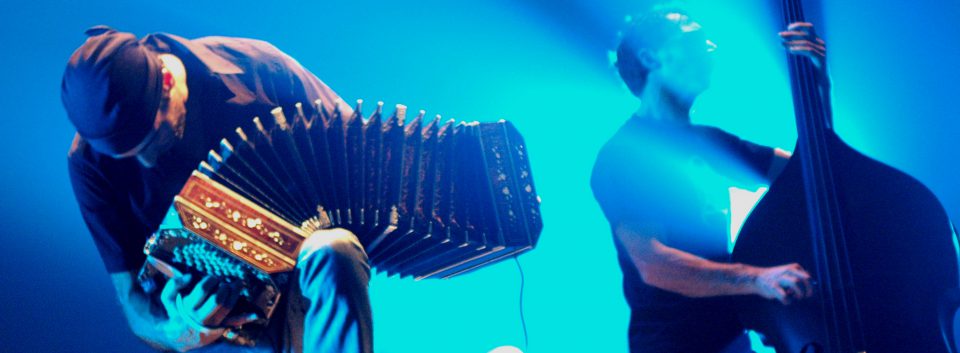
Chano Dominguez on an off night offers an unexpected treat

chano

VALENCIA. Pianist Chano Dominguez is in Valencia rehearsing a classical piece he wrote for brass quintet and piano for a July concert.(He’s working with Spanish Brass) But Chano, who has been living in the US for the past three years, decided he didn’t want to hang out at his hotel in the evenings so, without fanfare, he scheduled two nights of solo piano at Cafe Mercedes, an intimate club that feels like a living room. “I just want to play and see some friends,” he said in a sidewalk conversation before the show. (And I mean intimate, Club Mercedes by my rough count seats 60 people. Maybe)

Wednesday, playing on a stand up piano (yes, there was a concert piano somewhere behind the curtain but could not be used. Don’t ask.) he revisited “Marcel,” a piece for his youngest son, some Monk, a restless “My One and Only Love” and then invited Uruguayan violinist Federico Nathan (whom he had met the day before) to join him for three pieces that covered a lot of ground, from “I Got Rhythm” and “Footprints” to some Bartokian sidetrips.

Chano has integrated elements of flamenco and jazz in such an organic way that, at this point, discussing the parts means missing the whole. He has an unromantic, percussive attack and his single note runs sound more classical technique than bop. But what you really notice in his versions of standards is the pulse, an underlying beat that suggests flamenco and makes it all feel both familiar and different.

The highlight was the encore however, a mournful solo piano version of McCoy Tyner’s “Search for Peace,” which Chano turned into a meditation on the violence in Manchester. “I have two teenagers who go to those kind of concerts,” he said when introducing the song. He ended the piece ambiguously, fittingly unresolved.

Harold López-Nussa: from classical music to jazz, with unpretentious virtuosity

Cuba seems to produce pianists the way Brazil produces soccer players.
The quality and quantity of jazz pianists from Cuba, all seemingly raised in the most exacting classical school yet all seemingly just as fluent in the popular and jazz traditions, is just astonishing.
Consider Cuban jazz pianist and composer Harold López-Nussa, 34. He was born, and grew up, surrounded by music. His father, Ruy Francisco López-Nussa is a well-known drummer, his uncle Ernán, is an influential pianist, composer and arranger, founder of the groups Afrocuba and Cuarto Espacio and his late mother, Mayra Torres, was a piano teacher and a critical influence on his playing and outlook. “90% of what I am today I owe to my mother,” he once said. “When I was a child she was always on my side. She taught me the piano and also […] to know that it’s not the end of the world to make a mistake. That’s something you have to learn as well.”

López-Nussa and his trio, featuring his younger brother Adrián Ruy López-Nussa on drums and Julio César González on bass, play at the Rose & Alfred Miniaci Performing Arts Center on the Nova Southeastern University campus, presented by South Florida Jazz, Saturday at 8 p.m.

Continue reading

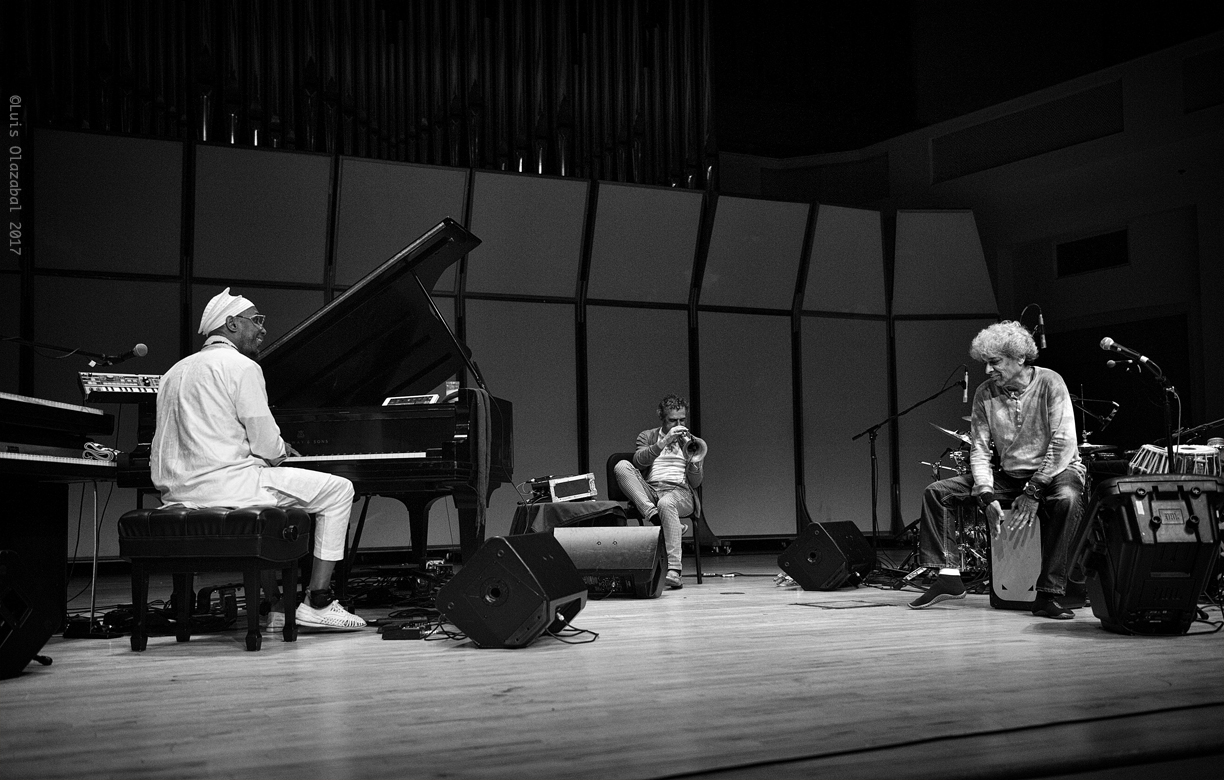
Out And About. Omar Sosa, Paolo Fresu and Trilok Gurtu tell stories

Omar Sosa, Paolo Fresu and Trilok Gurtu at the : Wertheim Performing Arts Center, FIU’s School of Music, Saturday.

Beautiful performance by the Omar Sosa, Paolo Fresu and Trilok Gurtu trio closing the 4th annual Miami International Jazz Fest, at FIU, Saturday. It seems redundant to speak of a very musical performance, but given that it was such a relief from the standard instrumental Olympics and that there was a lot of intense listening, use of dynamics and respect for space, sound and silence on stage, I´d say the point needs to be made. It was a truly musical performance.

At times, it was like overhearing a conversation between smart, well informed people: the subject almost didn’t matter; the thinking, what they had to say about whatever they decided to address and how they made their arguments, was enough. Saturday, Sosa & Co. could’ve played “Happy Birthday” for all that mattered. They probably would’ve made it interesting too.

There were no fixed roles. Instead, they took turns proposing themes, moods and tempos. On one piece, Fresu, on flugelhorn, just held a note throughout as Sosa bobbed and weaved around it, poking and retreating under Gurtu’s watchful eye. On another piece, Sosa and Gurtu engaged on a dialogue of vocal percussion, Gurtu drawing from the elaborate rhythmic patterns of Indian music; Sosa prodding and responding with bursts of Afro-Cuban rumba. Every piece told a story.By each song’s end you had a sense that you had been somewhere.

The trio doesn´t have a recording, but Sosa and Fresu have two as a duo, Alma (2012) and Eros (2016), both featuring Brazilian cellist and arranger Jaques Morelenbaum as a guest. Worth looking for them.

The evening started with a delightful set, running from Ellington and Basie to hip-hop, by the Dillard Center for the Arts Jazz Ensemble, from Ft. Lauderdale.

This big band from Dillard High School, directed by Christopher Dorsey, was celebrating having been picked among the top 15 high school jazz bands in North America — and for a good reason. I wonder what the old masters would’ve made of high schoolers playing their books with such proficiency, grace and aplomb.

Being selected for the Essentially Ellington High School Jazz Band Competition & Festival in New York City has become a bit of a habit for the Dillard High School Jazz Band. This is the seventh time it’s a finalist.(This is the 22nd edition of the annual event)If you heard them Saturday, you’d know why.

The event takes place at Jazz at Lincoln Center’s home, Frederick P. Rose Hall, on May 11. Congrats and good luck.