GroundUP Music Fest — no borders music and a breeze from the ocean.


_DSC4733

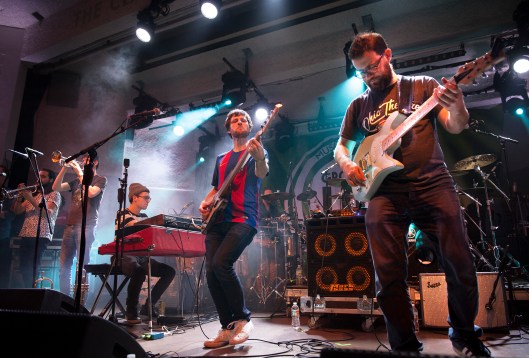
Snarky Puppy on their opening set at the GroundUP Music Festival at the North Beach Bandshell, Miami Beach, Friday. Michael League center. Photo by Luis Olazábal/Rhythm Foundation

By the time Snarky Puppy finished opening their set, unspooling one of its long, engaging musical tales, full of catchy melodies and various asides and side trips, night had fallen over the North Beach Bandshell on Miami Beach but still, it was 75 degrees, there was a slight breeze from the ocean and palm trees were swaying just so. You can’t blame Michael League, the band’s leader, composer, and bassist for being, let’s call it, uncharitably truthful, as he welcomed the audience to the second annual GroundUp Music Festival in “temperate Miami Beach while all our friends are freezing their asses back in New York.”

And yet, the great setting is only part of the story.

Continue reading

“Take Five ” — With A Pakistani Swing

The Sachal Ensemble performing at a jazz festival © Sachal Studios

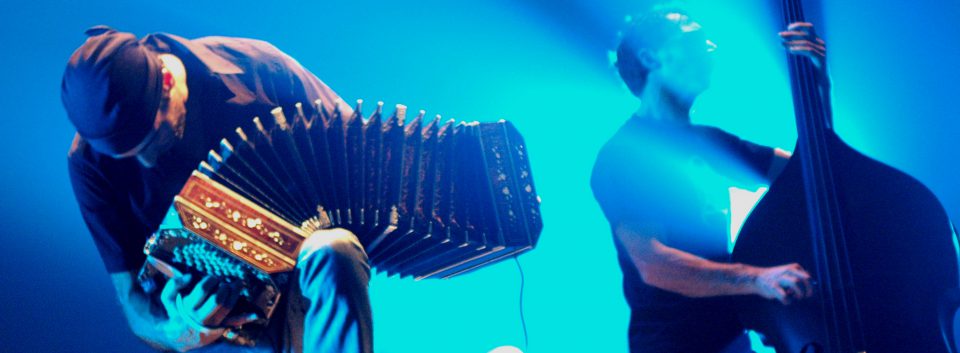
Globalization has produced many stories —not all inspiring. But having a Pakistani ensemble become a worldwide sensation by playing Paul Desmond’s immortal “Take Five,” which pianist Dave Brubeck turned into a hit nearly 50 years ago, has to be one of the most delightful — and improbable.

The 10-piece Sachal Ensemble, a group from Lahore, Pakistan, became an unlikely global sensation when the video of their performance of “Take Five,” a peculiar, swinging blend of South Asian classical music and jazz, got a million hits on YouTube. In a letter quoted in a story in Esquire Middle East, Brubeck, who got to hear it before his passing in 2012, wrote to producer Izzat Majeed: “This is the most interesting and different recording of ‘Take Five’ that I’ve ever heard. … Listening to this exotic version brings back wonderful memories of Pakistan where my Quartet played in 1958. East is East, and West is West, but through music the twain meet. Congratulations!”

The album that followed it, Sachal Jazz: Interpretations of Jazz Standards & Bossa Nova, became a best seller that topped the iTunes jazz charts. That led to world tours, appearances at jazz festivals and a celebrated performance with Wynton Marsalis at Lincoln Center in 2013, captured in Song of Lahore, a from-Lahore-to-New York documentary film by two-time Academy Award-winning director Sharmeen Obaid-Chinoy and Andy Schocken.

The Sachal Ensemble is appearing at the Olympia Theater in downtown Miami, Saturday. The concert opens MDC Live’s 2017-2018 season under the banner “Ojala/ Inshallah: Wishes from the Muslim World. ”

Continue reading

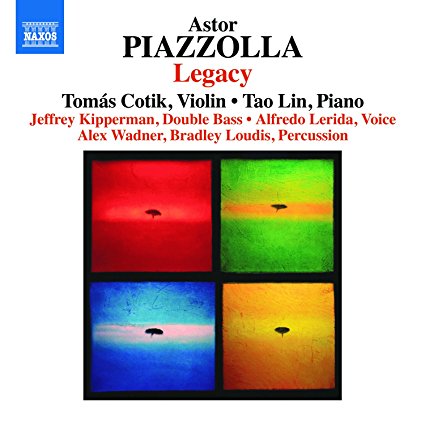
Legacy The Music of Astor Piazzolla by Tomás Cotik and Tao Lin


Very happy to share the news of the release of Legacy, a new recording of music by New Tango master Astor Piazzolla interpreted by violinist Tomás Cotik and pianist Tao Lin.
The program includes classics such as “Adiós Nonino”, “Milonga del Ángel”, Piazzolla’s Four Seasons”, “Balada para un loco” and two personal favorites, “Escualo” and “Fracanapa.”
For a one-stop place for information, videos and points of sale check Naxos.

Tomás and I had collaborated on a couple of Piazzolla-related projects during his time in Miami, so when he told me about Legacy, I jumped at the opportunity to write the liner notes. Piazzolla´s story and Tomás playing are tales worth telling.
I hope the notes intrigue you into checking this recording. You will not be disappointed.

Notes for Astor Piazzolla Legacy

New Tango master Astor Piazzolla (11 March 1921–4 July 1992) packed a lot of living in his writing and his playing.

Tango is the music of Buenos Aires — but the man who would challenge so many of its traditions and clichés, and in doing so would bring it kicking and screaming into a new world, was not even a porteño, as the inhabitants of Buenos Aires are called. Astor Piazzolla was born in Mar del Plata, a resort town on the Atlantic coast of Argentina, about 250 miles south of Buenos Aires. When he was just 4, his family moved to New York’s Lower East Side, then to a tough neighborhood populated by gangsters of seemingly every denomination. He was short and walked with limp because of a birth defect, so he fought his way to respect. The other kids called him “Lefty,” acknowledging his punch.

Continue reading